Photographs

What came out of the pond.

A catch record requires you to accept someone else's word, whereas photographs do not. Each of the fish mentioned was caught, recorded in the log, photographed, and then returned; by publishing the photographs, the identifications associated with the numbers can be verified by anyone who knows these species better than we do.

The site

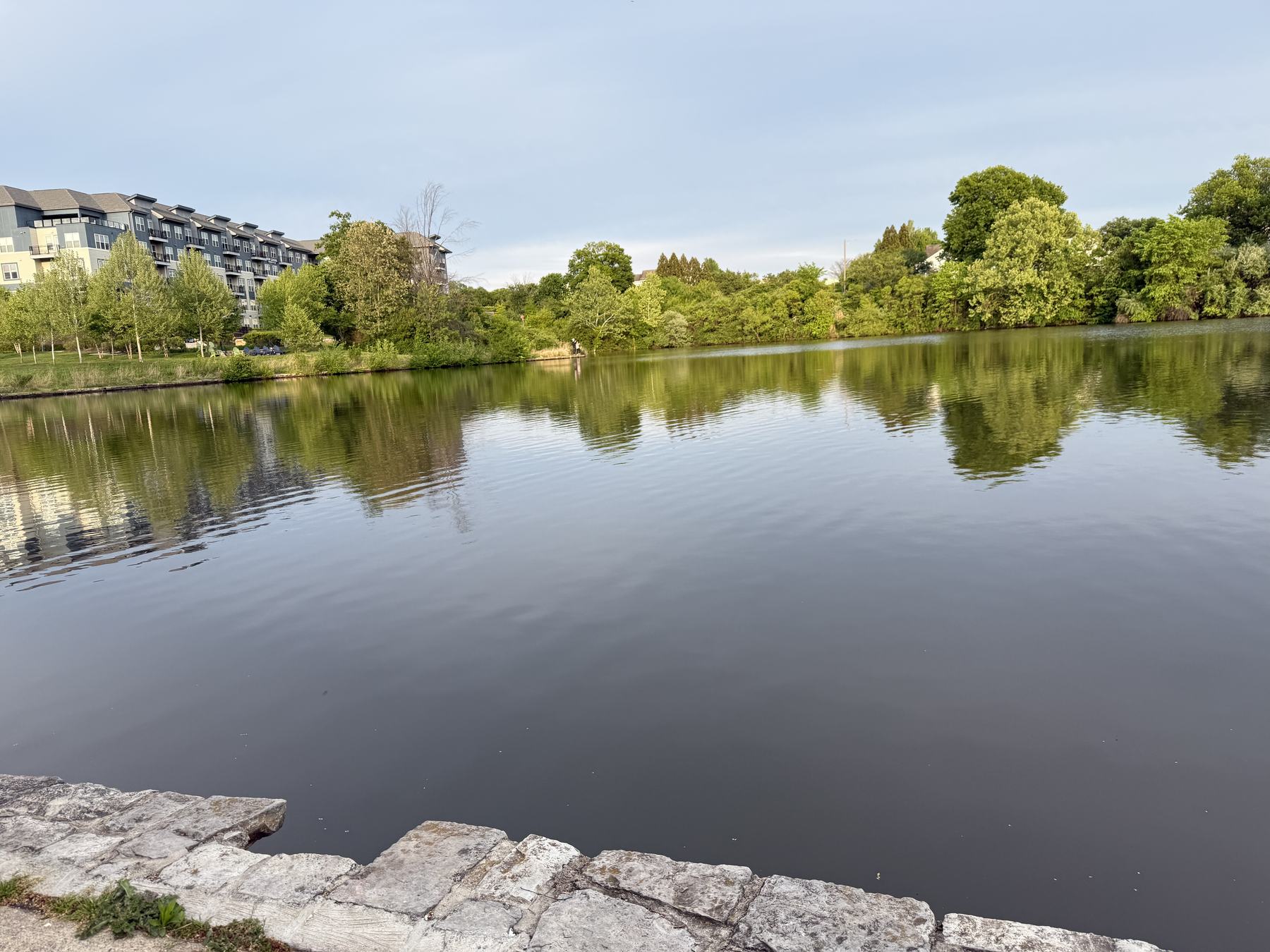
The retention pond seen from stone rip-rap on its southern bank; apartments and treeline reflected in still water on a calm evening.
The pond in summer, from the sampling bankThe rip-rap in the foreground is the fixed position every session was fished from. Apartments to the left, wooded margin to the right — the flat, calm conditions typical of a late-afternoon session.
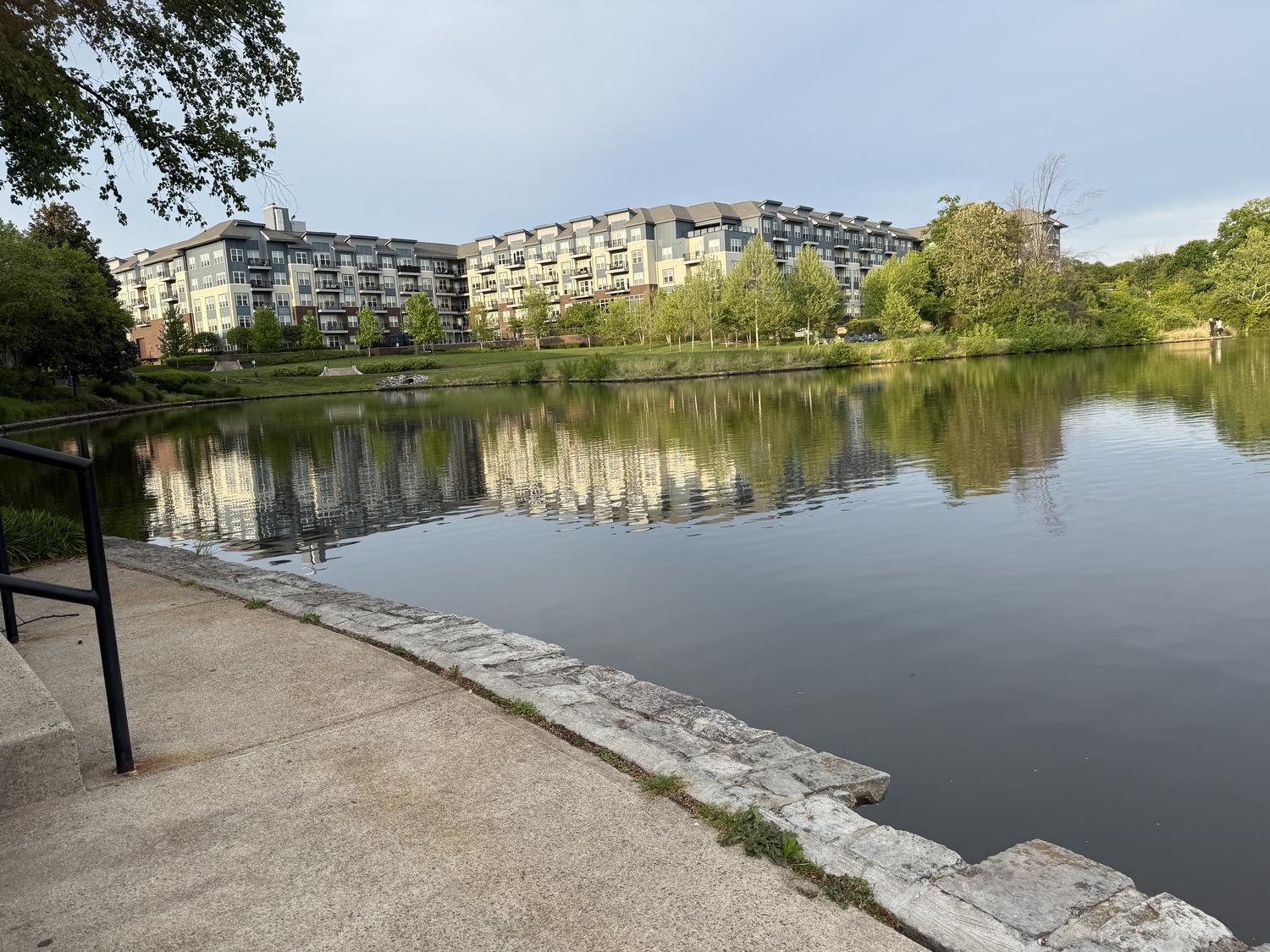
A concrete path and handrail leading down to a cut-stone pond edge, with apartment buildings reflected in the water beyond.
The access pointConcrete apron, handrail and cut-stone edge armouring the bank against wave action. This is engineered shoreline, not a natural one — easy to forget once the water is full of fish.
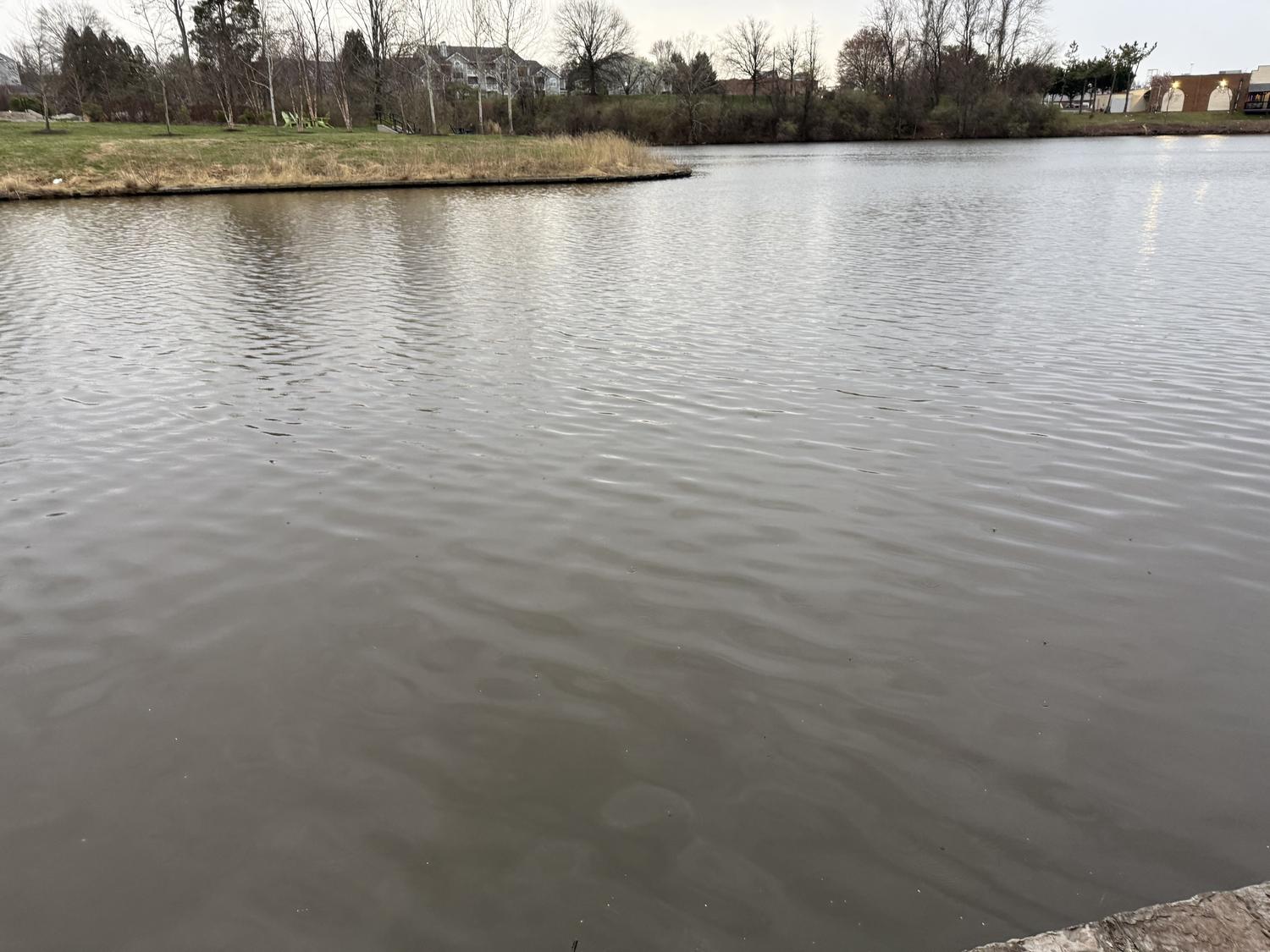
The pond under a flat grey winter sky, bare deciduous trees and dormant grass along the far bank.
The same pond in winterBare trees, dormant grass, commercial frontage across the water. No sampling happens in this season: every number on this site comes from May to August, and this is what the eight unsampled months look like.
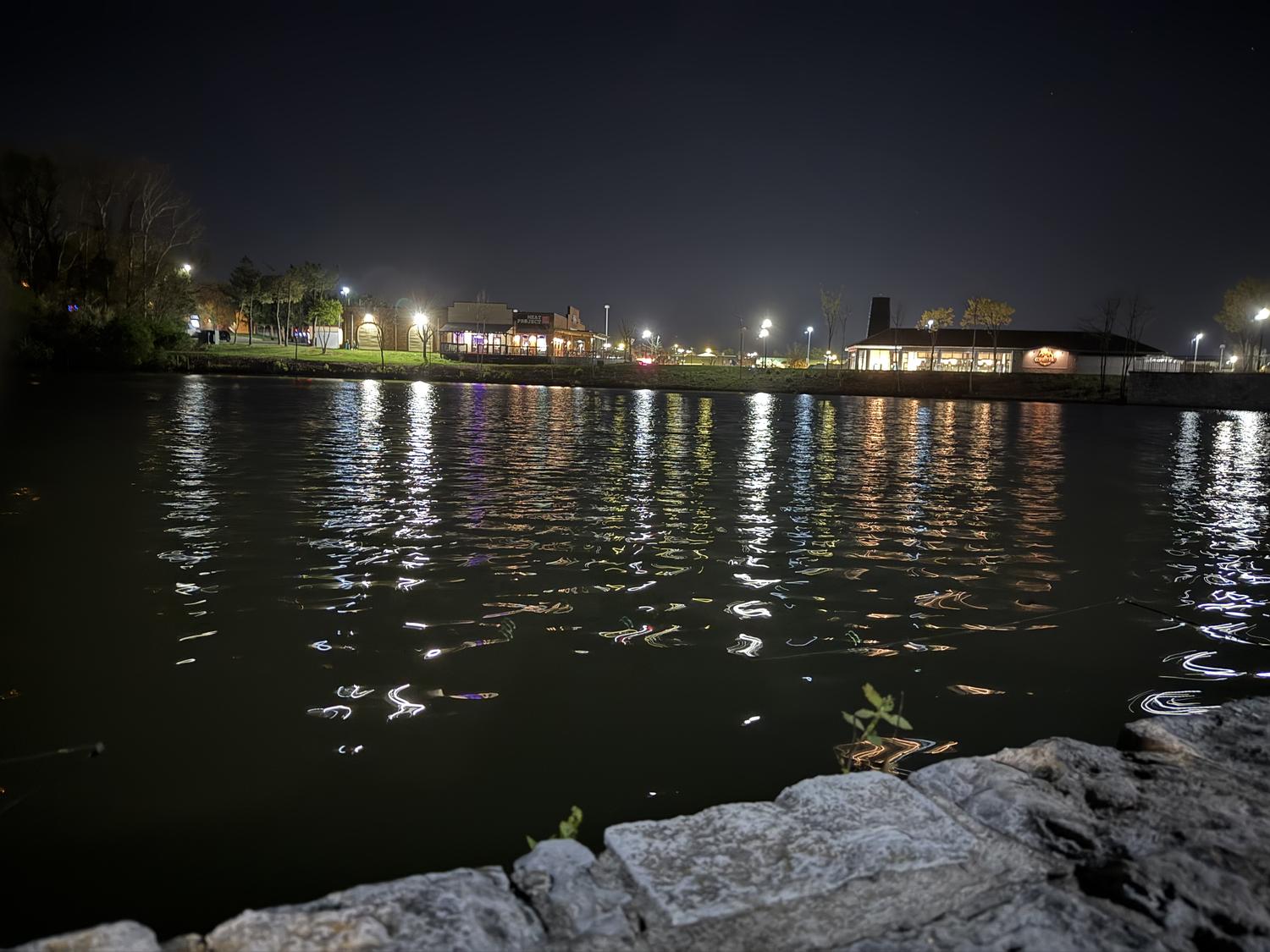
The pond at night with restaurant and street lights on the far bank reflected in long streaks across the water.
After darkRestaurant and car-park lighting on the far bank. The pond sits inside a working commercial landscape, and the runoff it holds comes off those roofs and that asphalt.

How the record was made

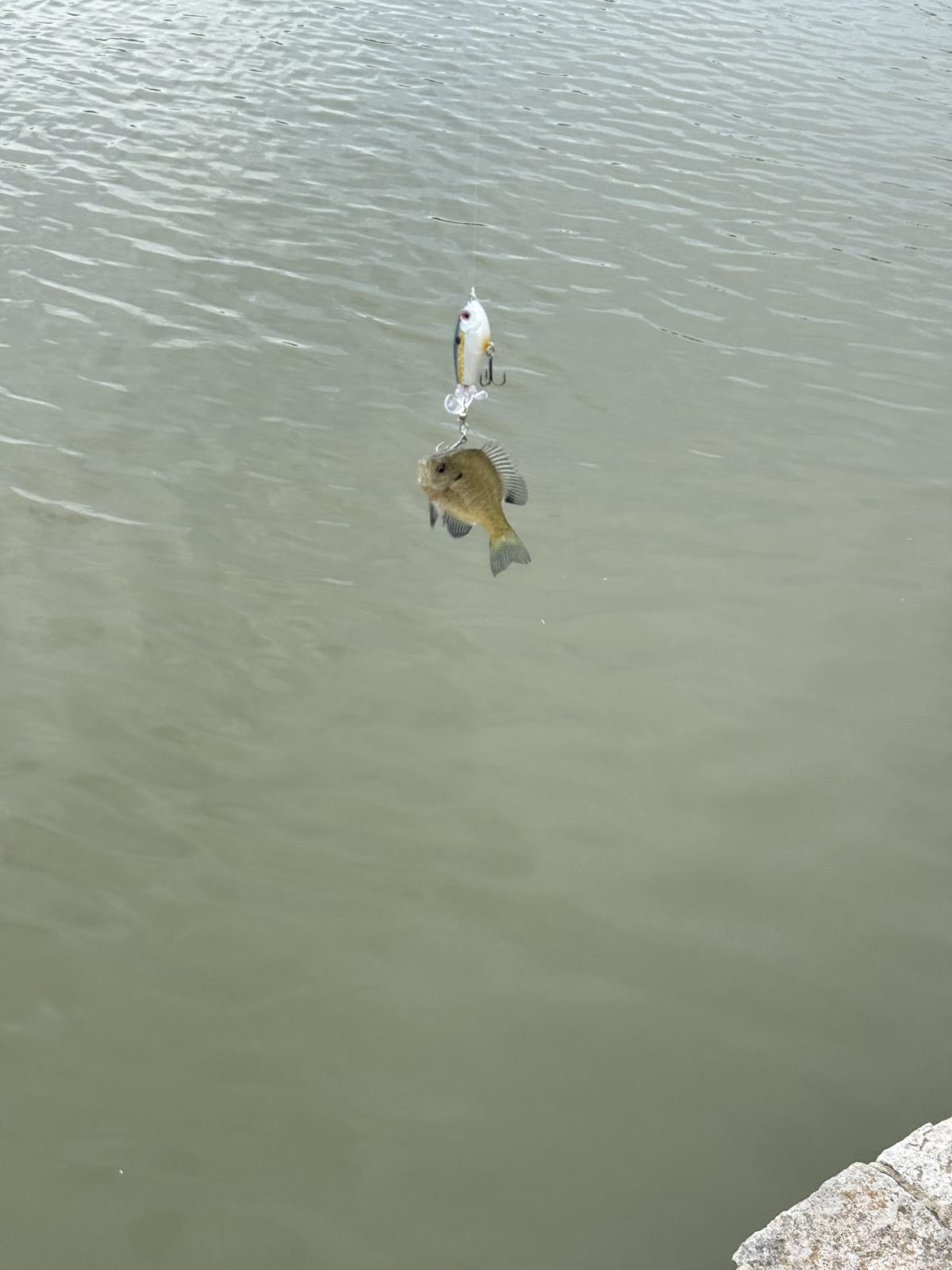
A small white and gold crankbait lure hanging over the water with a little sunfish hooked on the trailing treble.
The gearA small crankbait with a sunfish on the trailing treble, lifted clear of the water. What a hook can catch is set by what it is: lure size, hook size and bait all decide which fish enter the record and which never do.
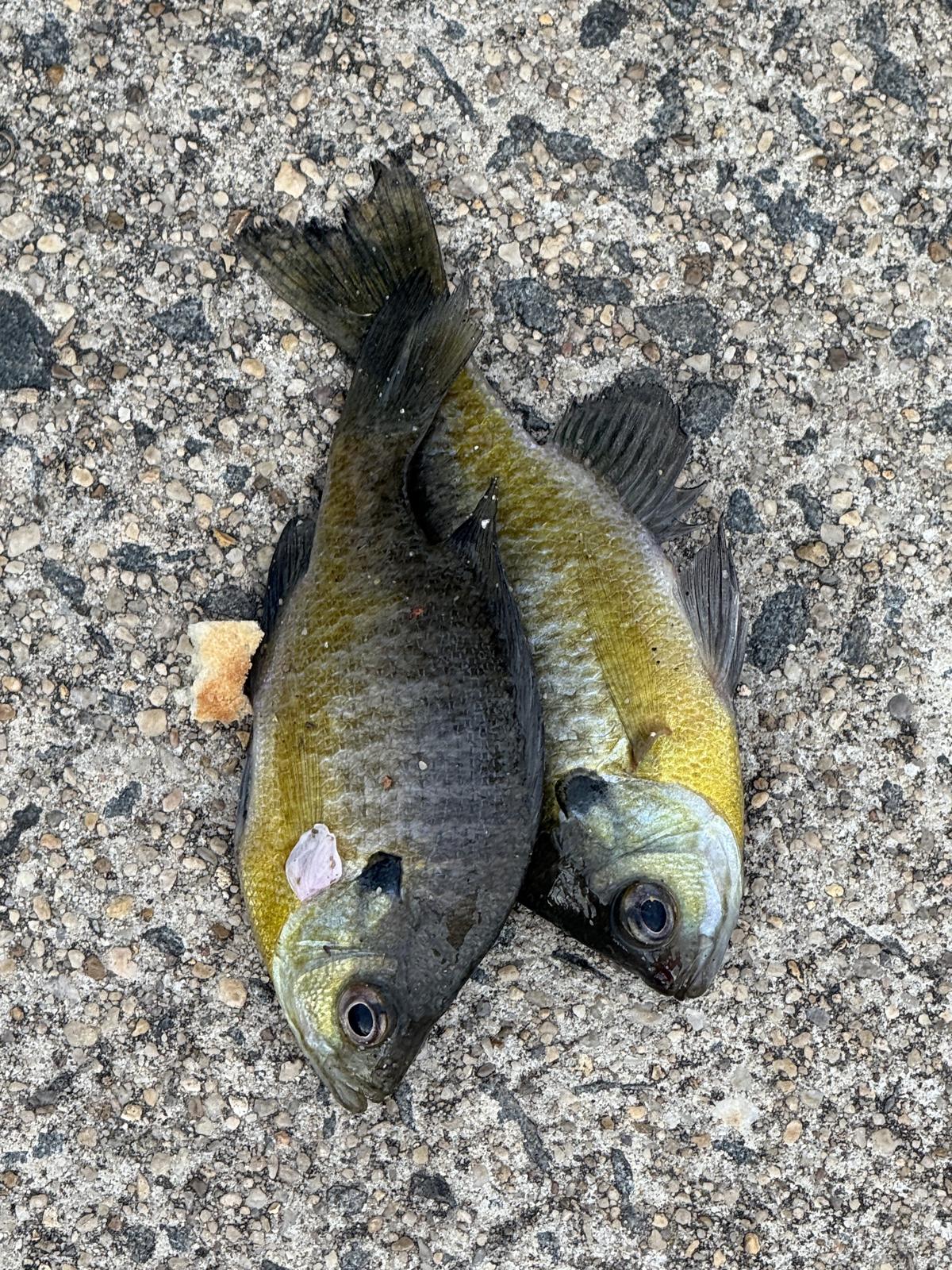
Two bluegill lying side by side on aggregate concrete with a small piece of bread next to them.
Bread as baitTwo bluegill on the concrete with a piece of bread beside them. Bait selects for what will eat it — bread draws sunfish, and a bottom bait draws catfish, which is one reason a catch record describes a method as much as a pond.
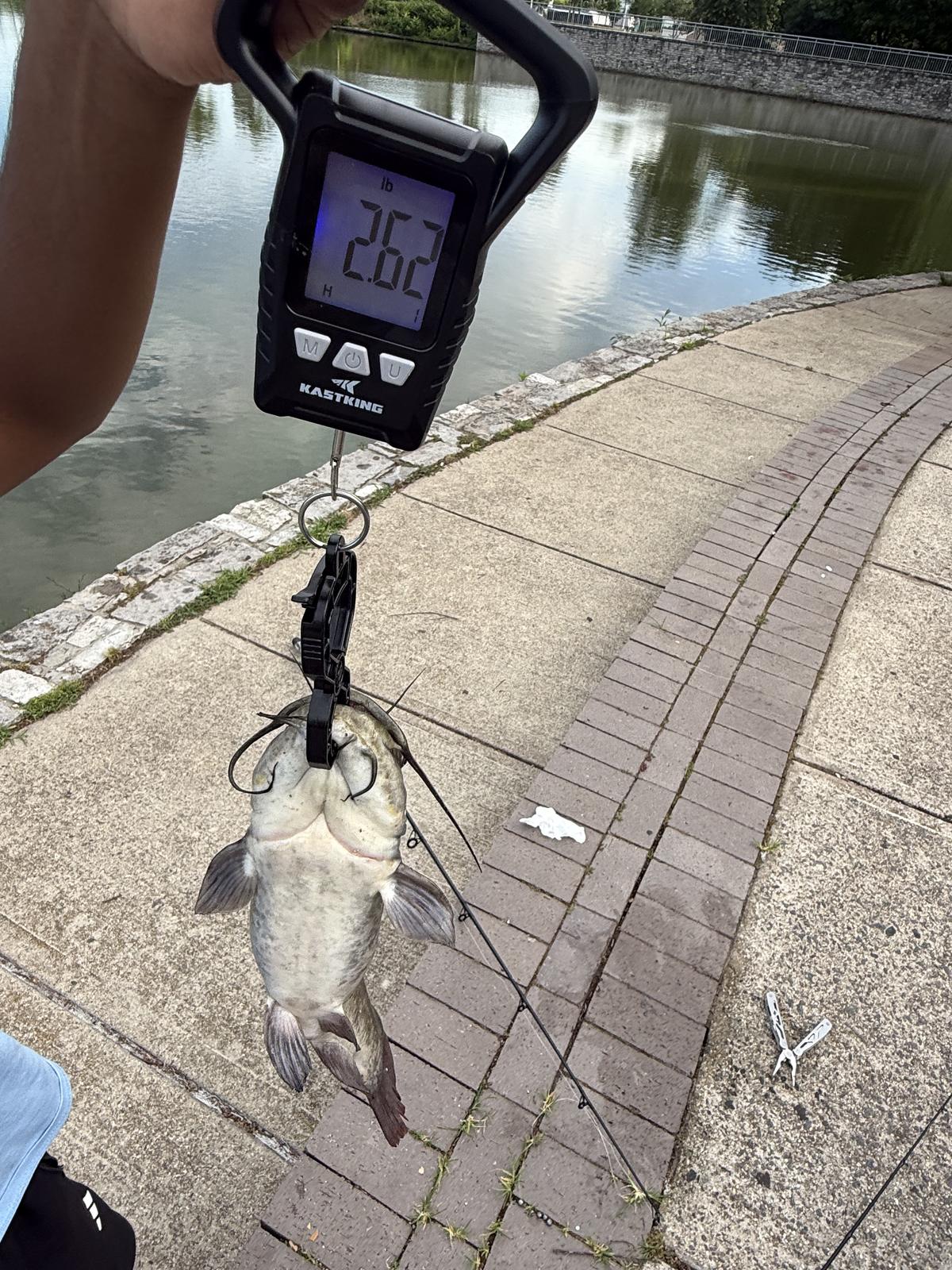
A channel catfish hanging from a black digital fishing scale reading 2.02 pounds, held above a paved path beside the pond.
The scale — 2.02 lbA channel catfish on a digital scale reading 2.02 lb, with the pond behind. Fish were being weighed in the field. These weights are not in the dataset: the log records species and counts only, so every reading like this one exists as a photograph and nothing else.
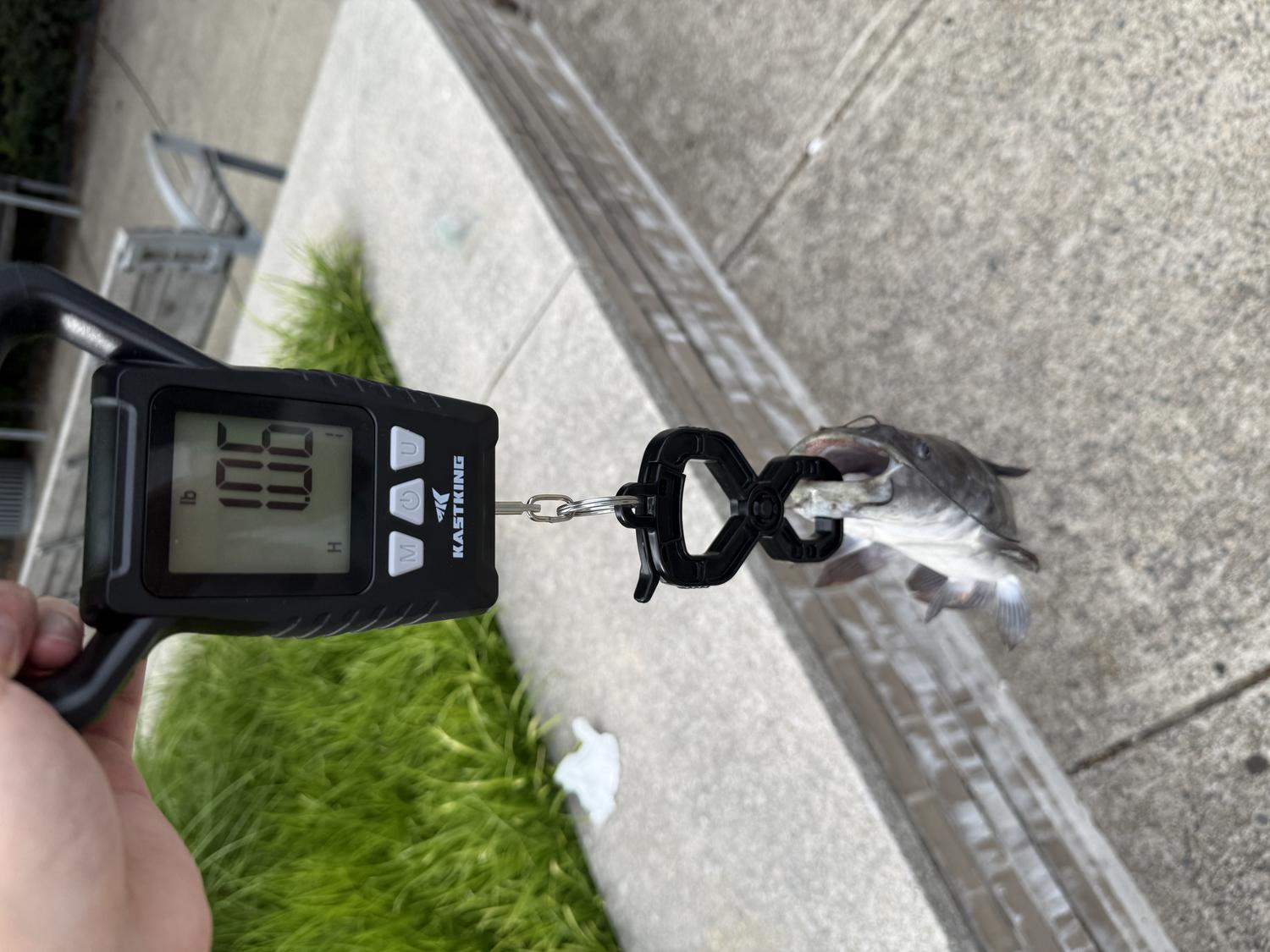
A digital fishing scale reading 1.06 pounds with a catfish suspended from its clip.
The scale — 1.06 lbA second weighing, this one reading 1.06 lb. Two records of the same measurement, taken on different days, neither of which reached the spreadsheet.
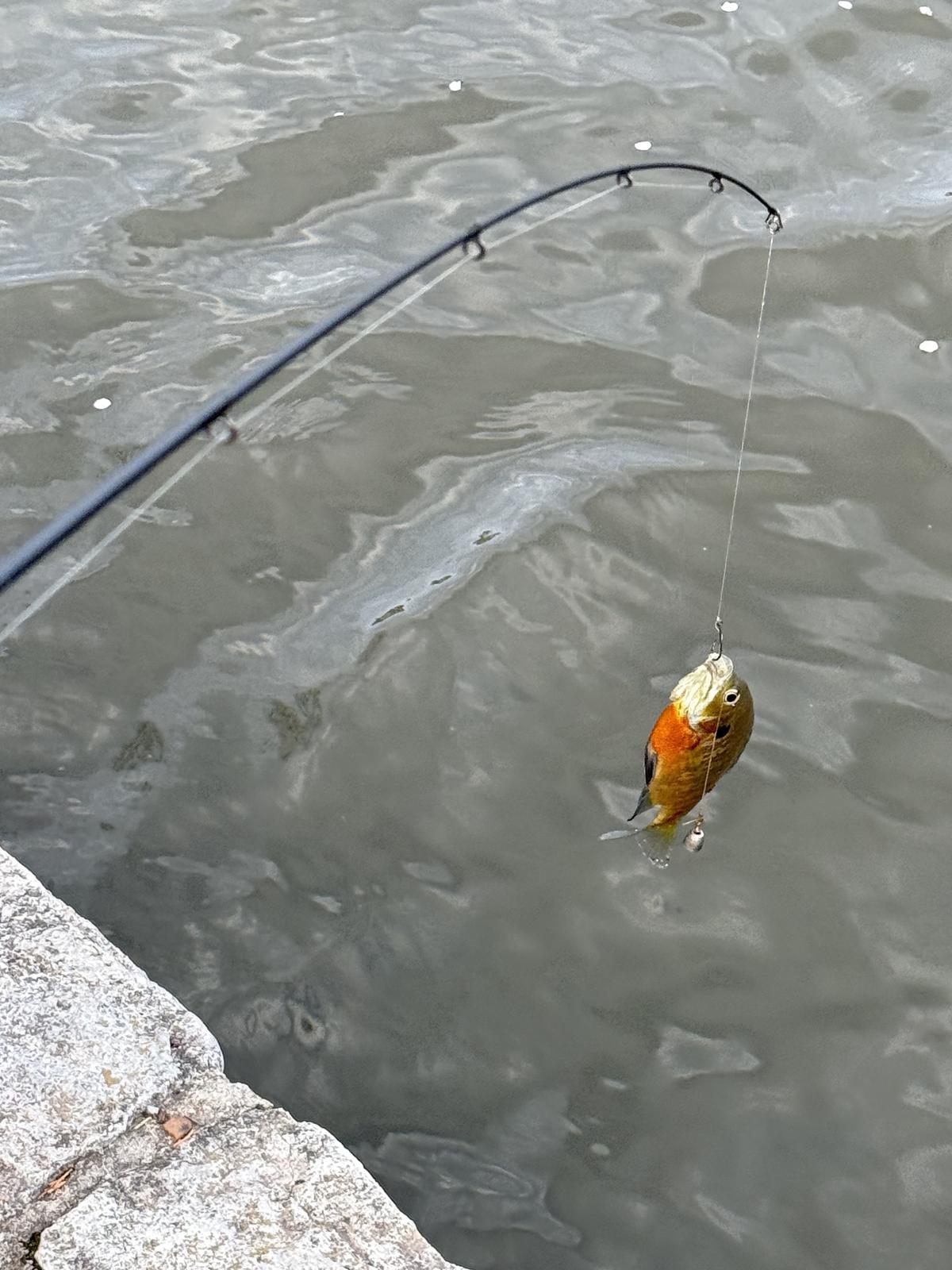
A small orange-breasted sunfish hanging from a fishing line at the tip of a bent rod, above grey water.
On the lineA sunfish at the rod tip on the way in, orange breast showing. The bend in the rod is the whole of the sampling instrument: one person, one rod, one stretch of bank.

Bluegill — 257 fish, every session
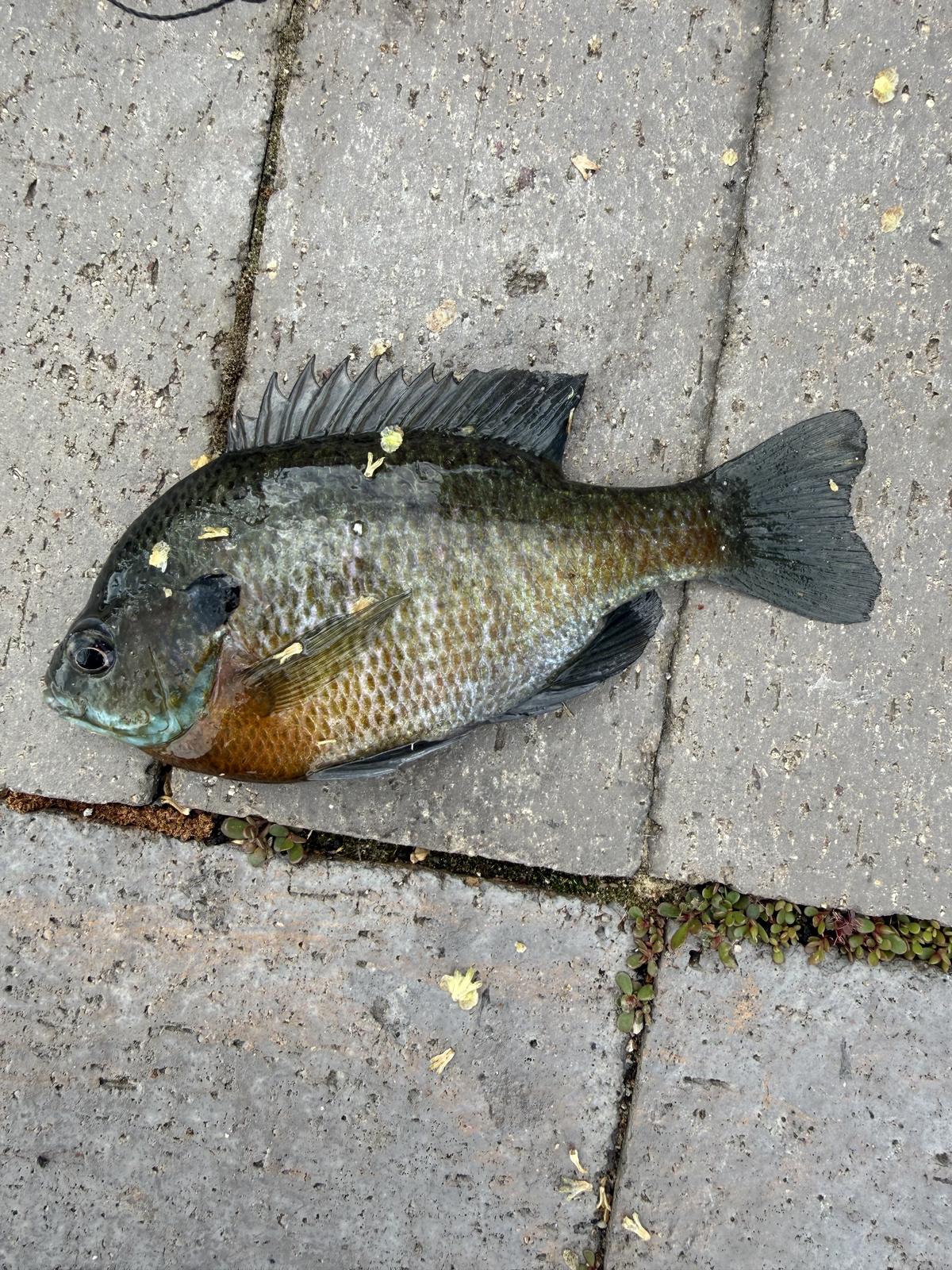
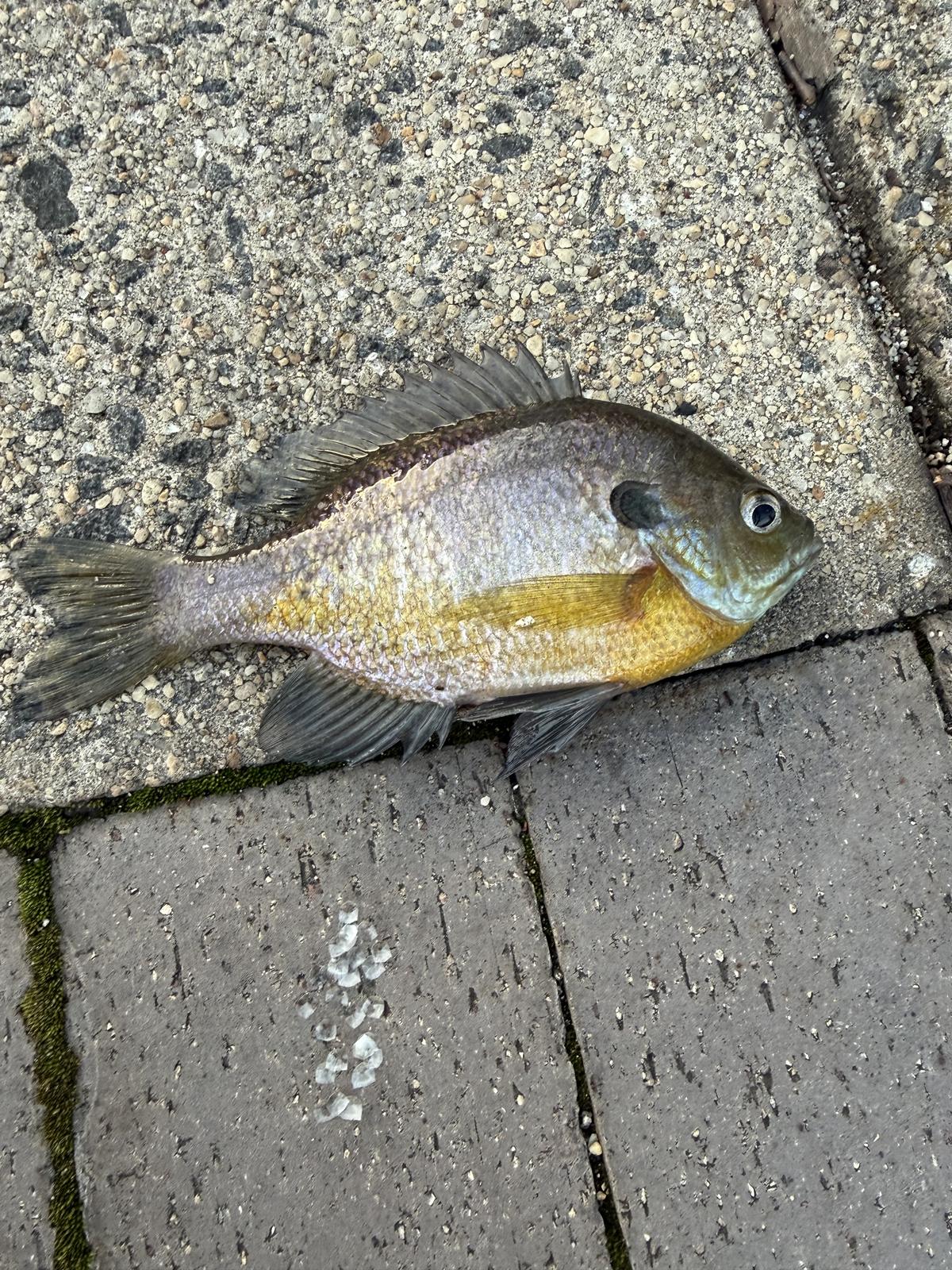
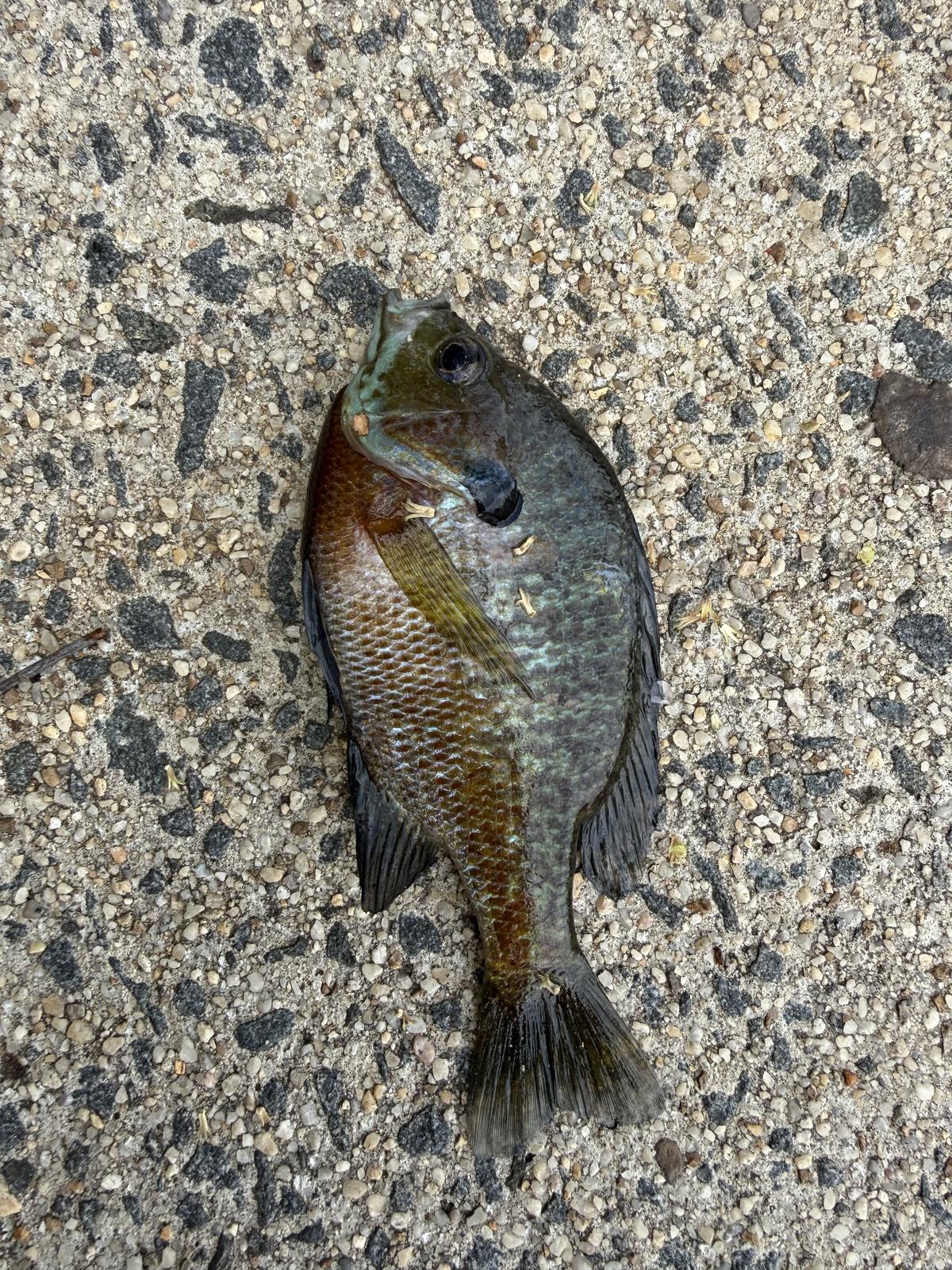
A large bluegill lying on paving stones, olive-backed with a rust-orange belly and a black gill-cover flap.
BluegillThe species that appeared in every one of the 48 sessions and made up 257 of the 525 fish recorded — 49 per cent of the whole catch. Dark flap at the rear of the gill cover, deep compressed body, small mouth.
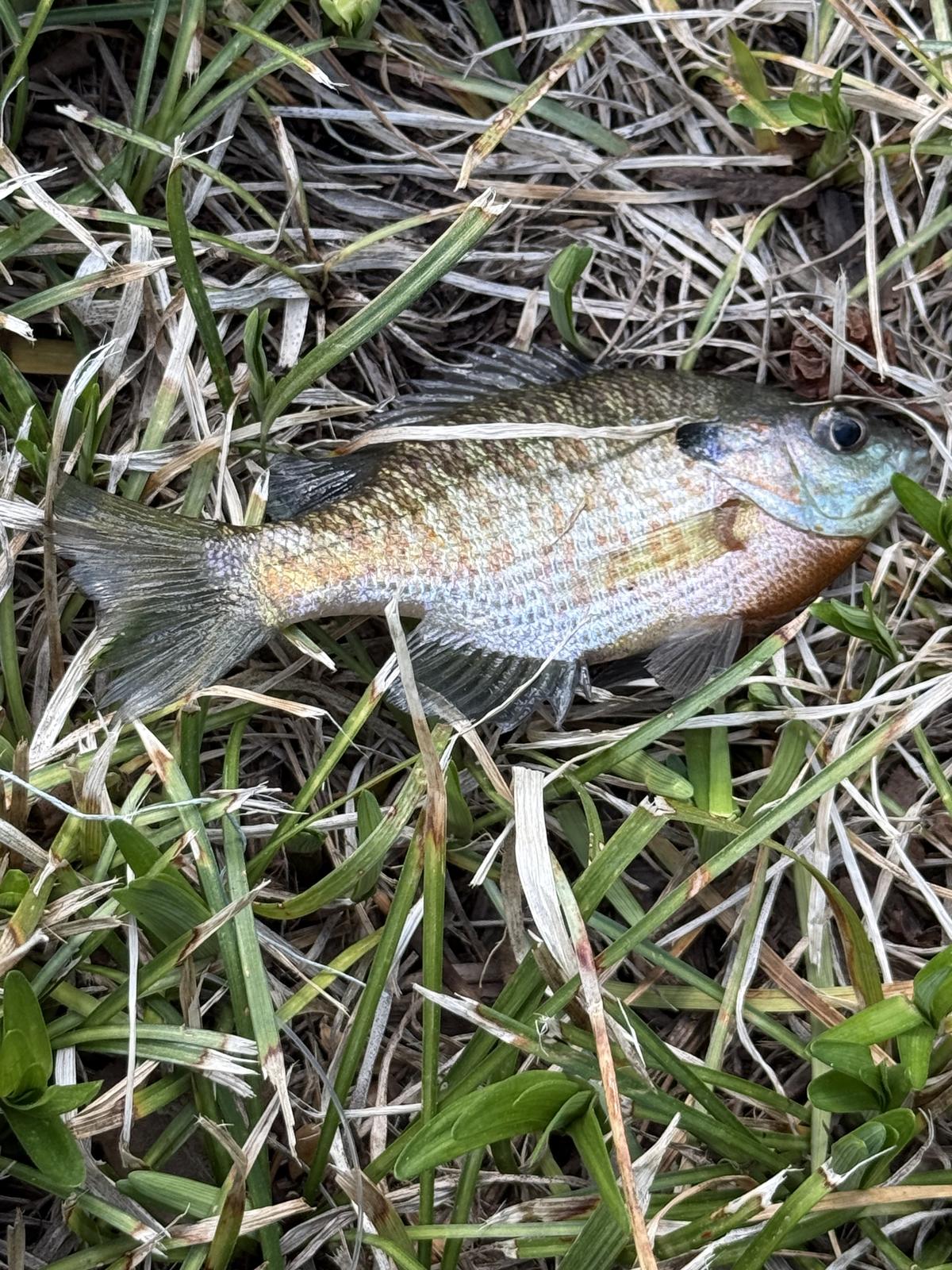
A brightly coloured bluegill lying in short grass, showing copper, blue and orange iridescence.
In the grassCopper and blue-green iridescence along the flank, orange breast, black opercular flap. Colour like this fades within minutes of a fish leaving the water, which is another reason photographs matter to the record.
A pale silvery bluegill on grey paving stones, with orange on the lower body and a dark gill-cover spot.
Pale phaseSilver-lilac flanks with a yellow-orange breast. Bluegill colour varies with sex, season and stress, which is much of why sunfish are hard to identify from photographs alone.
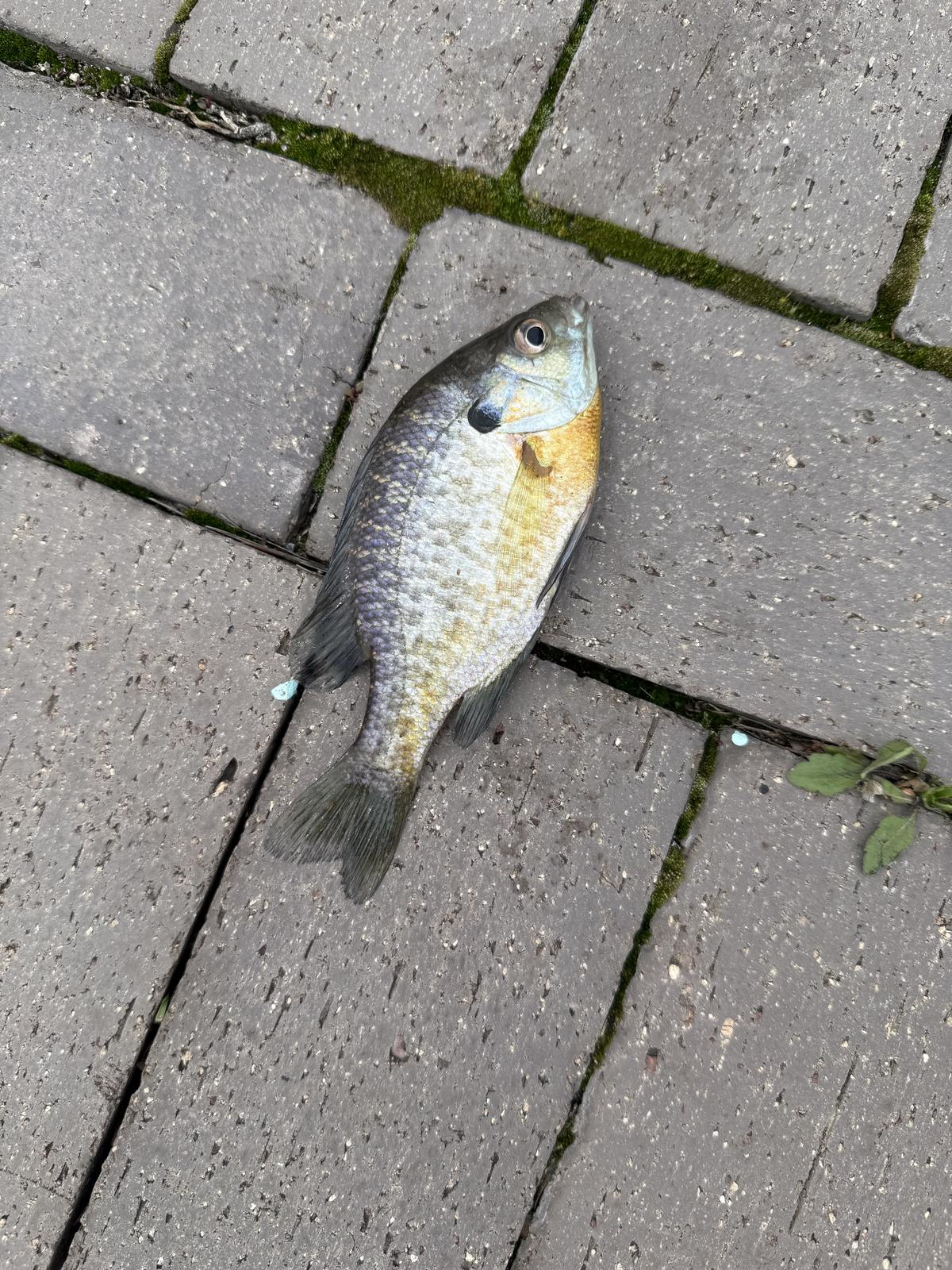
A bluegill lying on aggregate paving, showing a yellow-orange belly and a dark gill-cover spot.
Another individualSame species, different fish, same stretch of bank. The consistency across four years is the point: bluegill were never once absent from a session.
A bluegill on aggregate concrete showing strong rust-orange colour along the flank and a black gill-cover spot.
Breeding colourThe rust and copper wash across the flank develops on males through the spawning season, which in Virginia runs from late spring into summer.
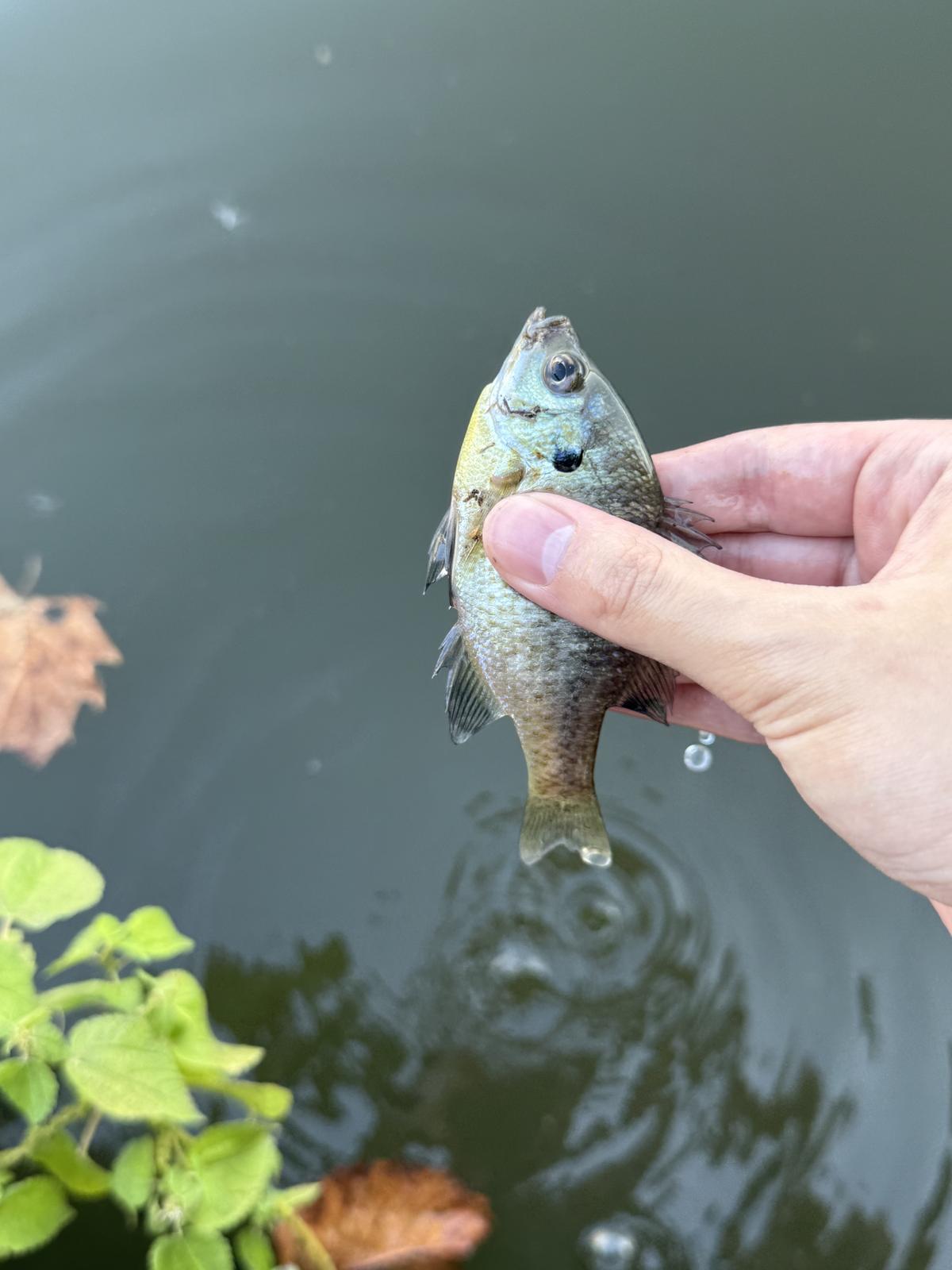
A bluegill held just above the pond surface, water dripping from its tail, green leaves at the edge of the frame.
Going backHeld just above the surface at release, still wet. Every fish in this record was returned to the water.

Catfish and bullhead — 190 fish
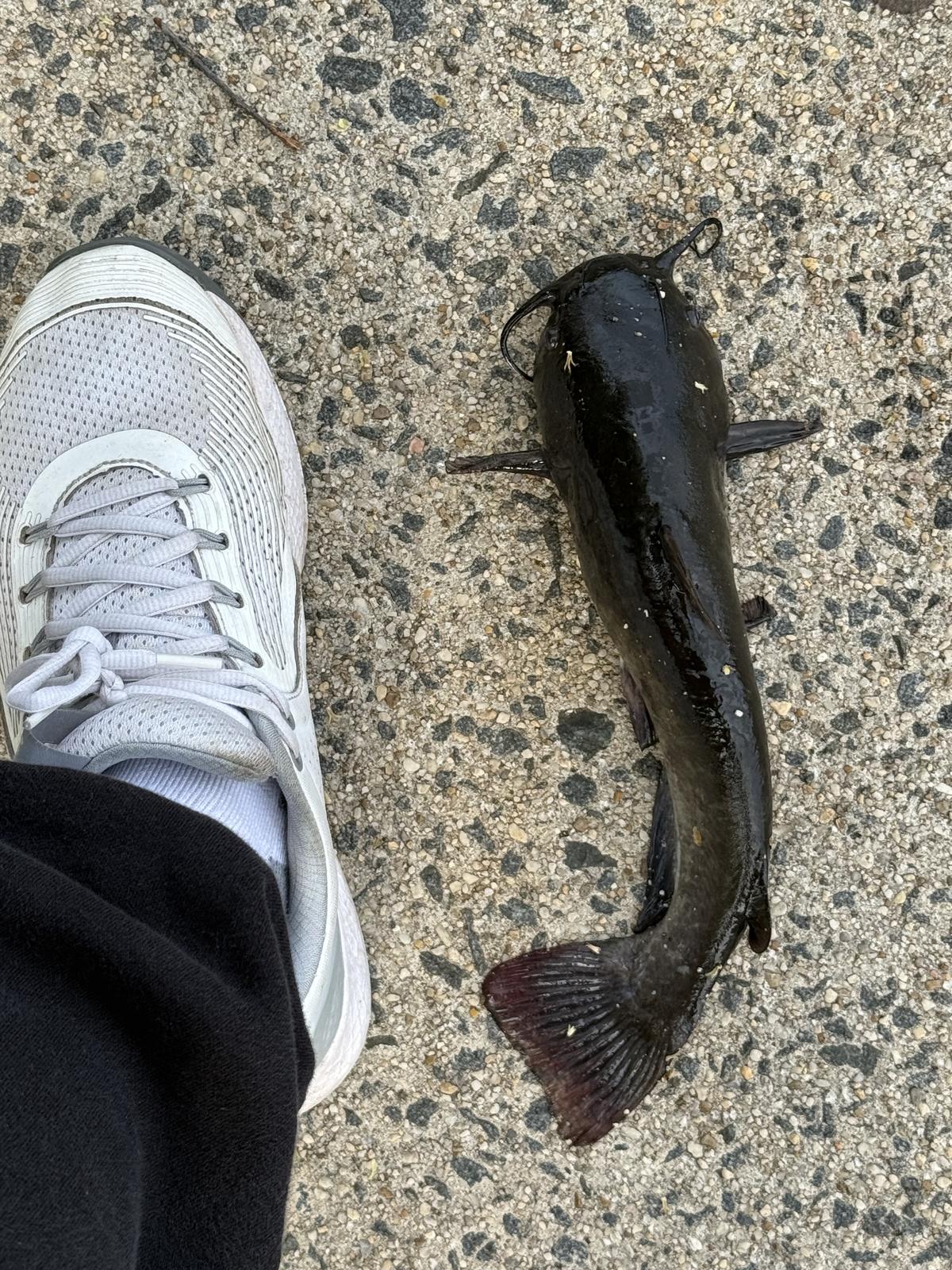
A dark catfish lying on aggregate concrete beside a white trainer, giving a sense of its length.
With a shoe for scaleA shoe in frame turns an illustrative photograph into a measurable one. The rounded tail here points to brown bullhead rather than channel catfish, which has a deeply forked tail. The two together are 190 of the 525 fish recorded.
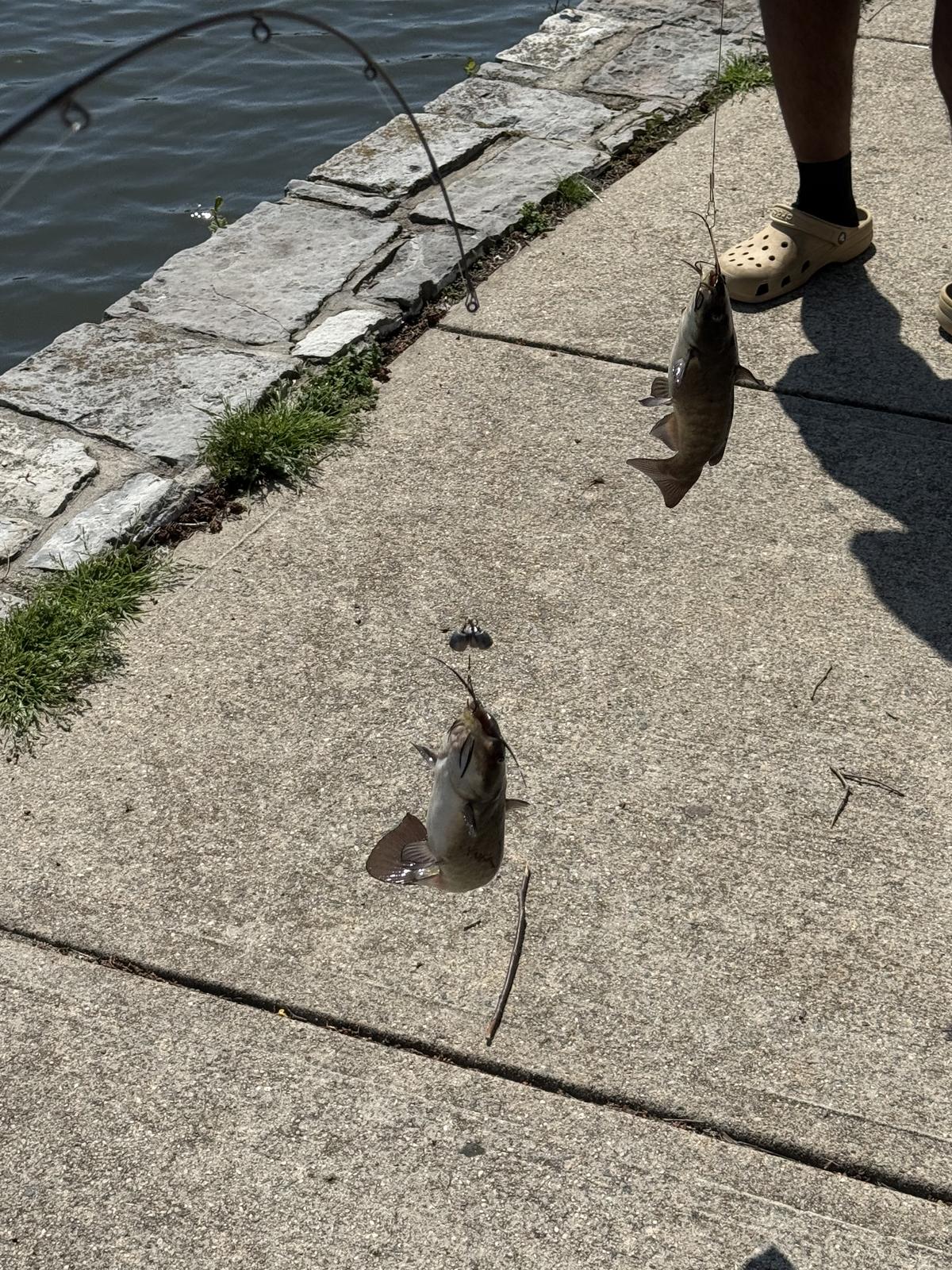
Two small catfish on a sunlit concrete path beside the pond, one hanging from a line and one lying on the ground.
Two in one sessionBoth fish from the same afternoon, one still on the line. Catfish sessions look different from sunfish sessions — fewer fish, larger ones, and usually later in the day.
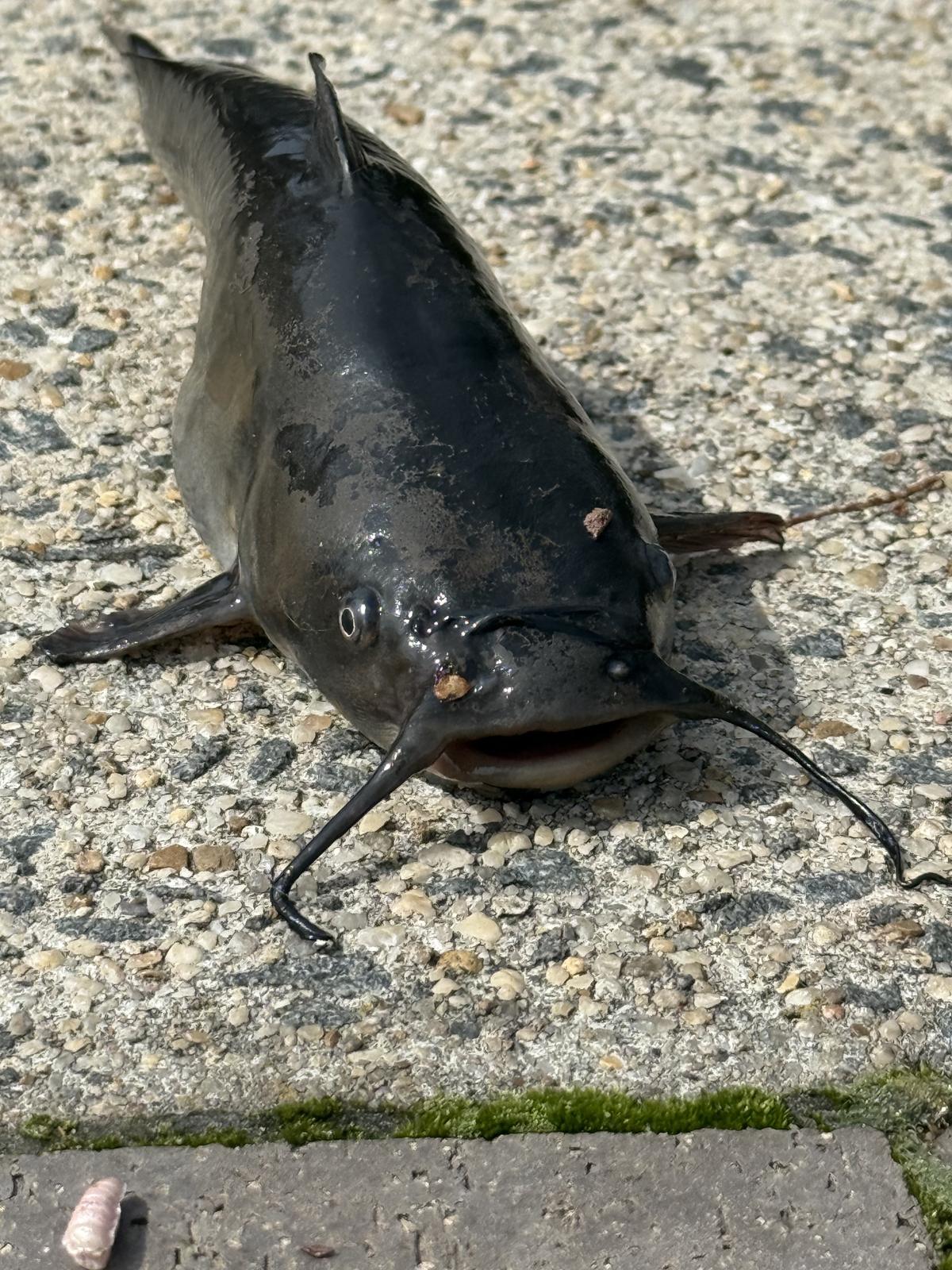
A dark catfish lying on sunlit concrete with its long barbels spread to either side.
Barbels spreadThe four pairs of barbels are the chemosensory organs a bottom-feeding fish uses to find food in water too turbid to hunt by sight — which describes this pond through most of the summer.
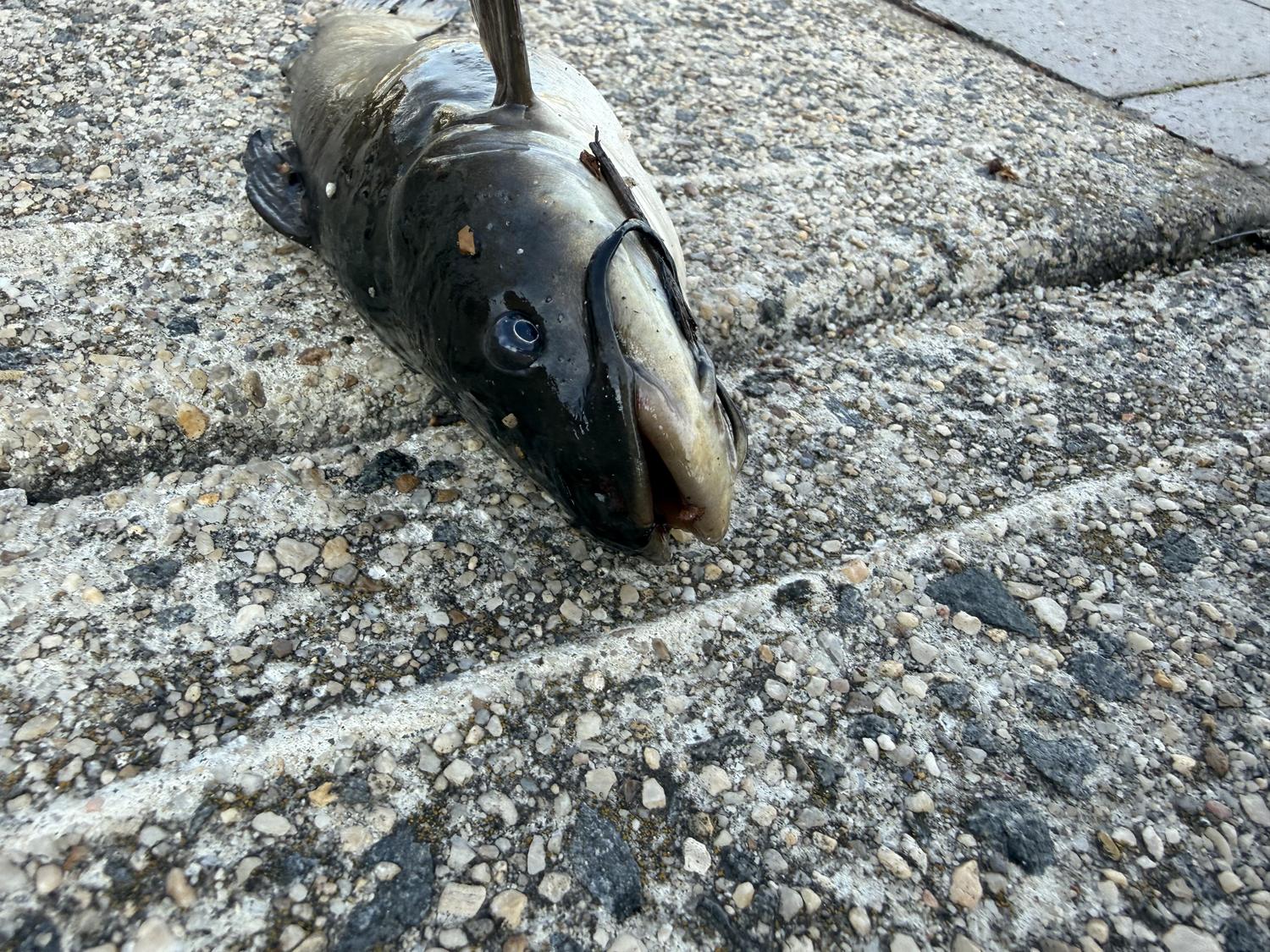
A close-up of a bullhead's head lying on concrete, mouth open, with dark barbels curving back along the jaw.
The mouth, close upA wide, flattened mouth set at the front of a broad head, with dark barbels curving back along the jaw. Built for finding food by touch and taste on the bottom rather than chasing it down in open water — the opposite strategy to the bass one section down.
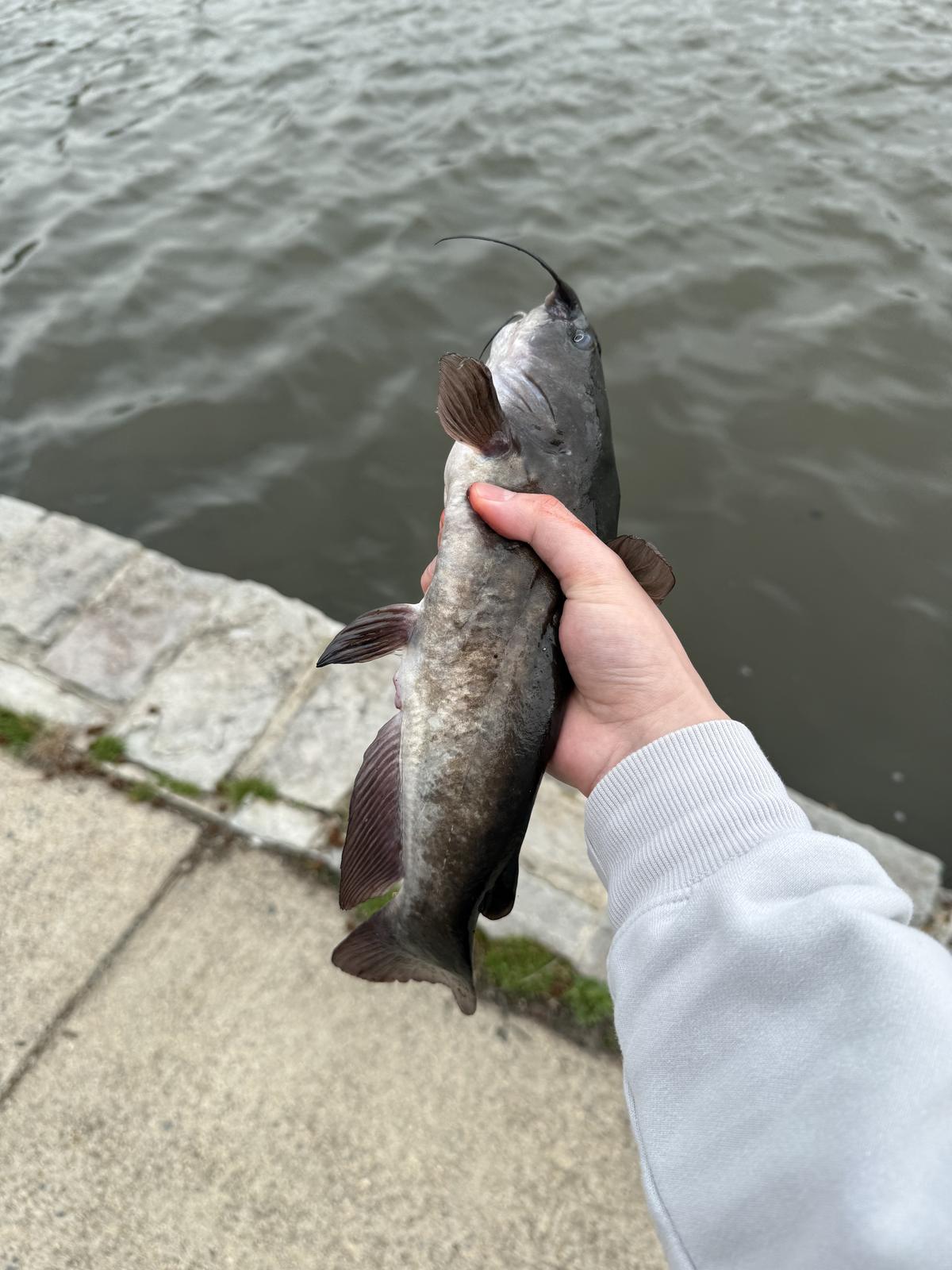
A pale grey catfish held above choppy grey water, with a cut-stone bank behind.
Cold-season fishHeld above the water in winter conditions — grey chop, sleeves down. Pale grey body with a notched tail, consistent with bullhead catfish.
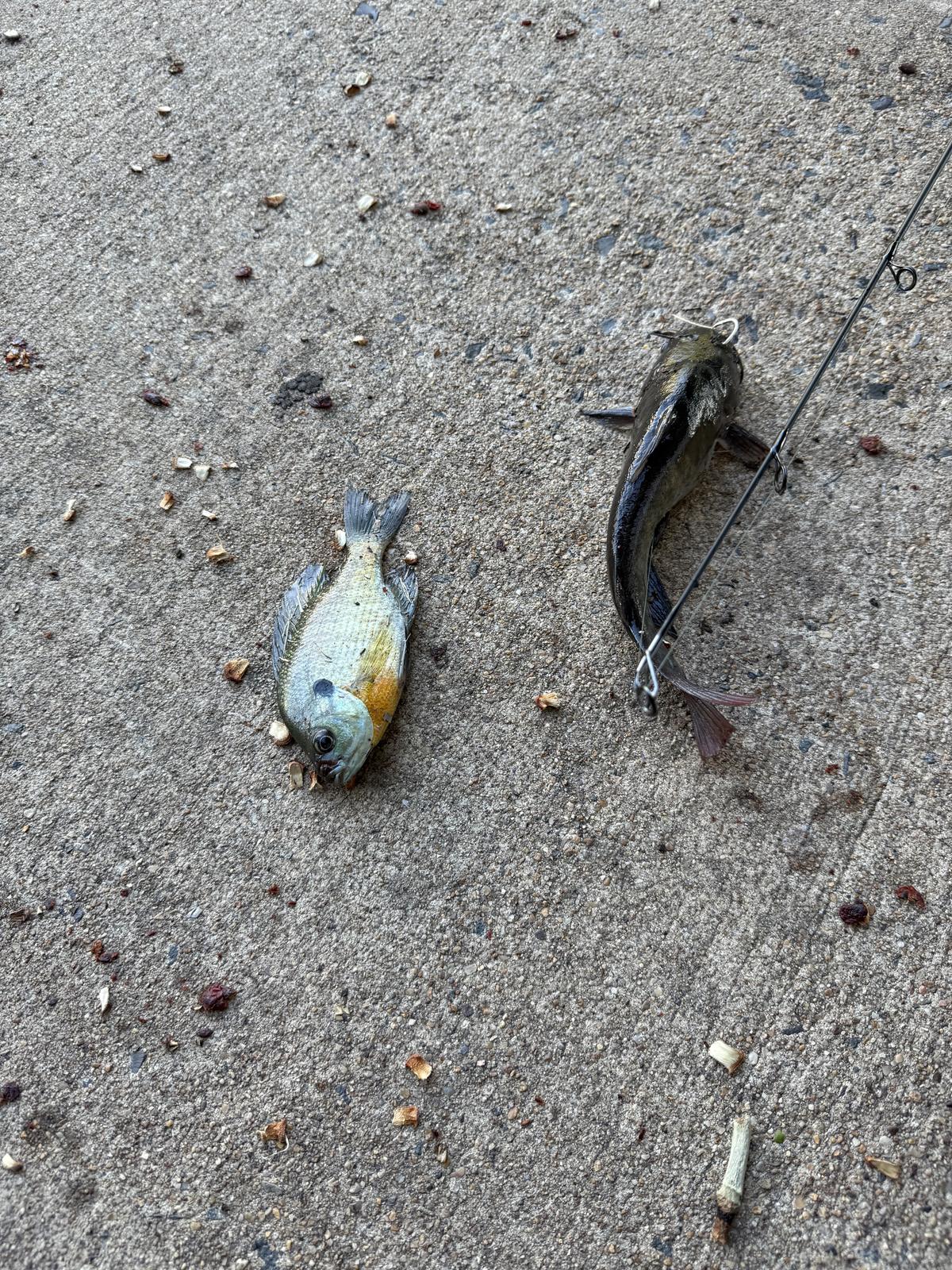
A bluegill and a small dark catfish lying side by side on concrete beside a fishing rod.
Two species, one sessionA sunfish and a catfish from the same afternoon. Bluegill and bullhead together account for 79 per cent of everything caught across four summers.

Largemouth bass — 38 fish

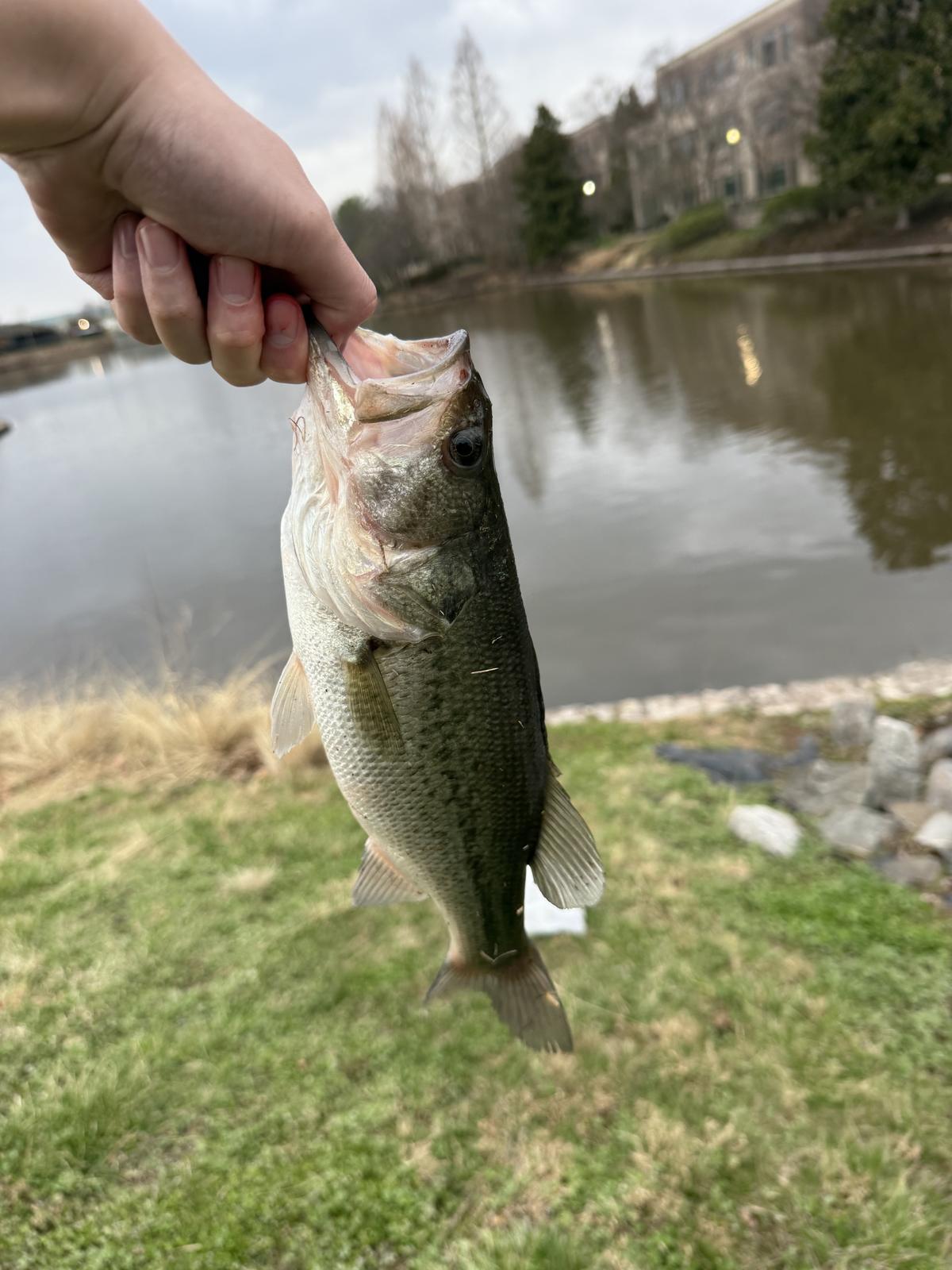
A largemouth bass held by the lower lip beside the pond, bare winter trees and an office building across the water behind.
Largemouth bassThe jaw extends back past the eye — the field mark separating largemouth bass from every sunfish in this pond. Note the bare trees and dormant grass: this fish was caught outside the May–August sampling window, so it is not among the 38 bass in the record.
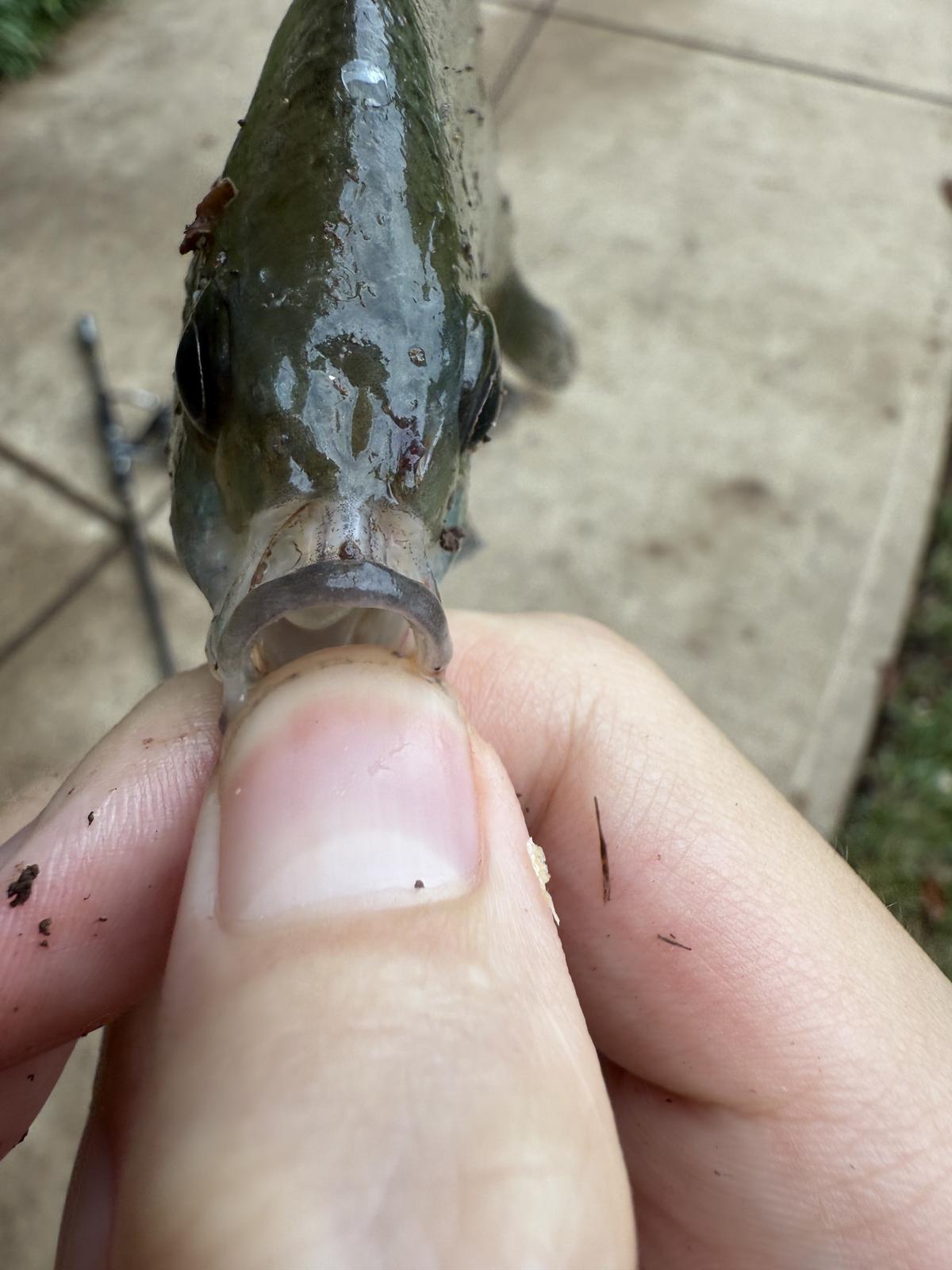
A close-up of a small greenish fish held by its lower lip, mouth open, jaw extending past the eye.
The diagnostic, at close rangeThe same feature on a much smaller fish. Bass were 38 in four years, and none at all across twelve August sessions.

What the method cannot count

Most of what lives here is not in the data

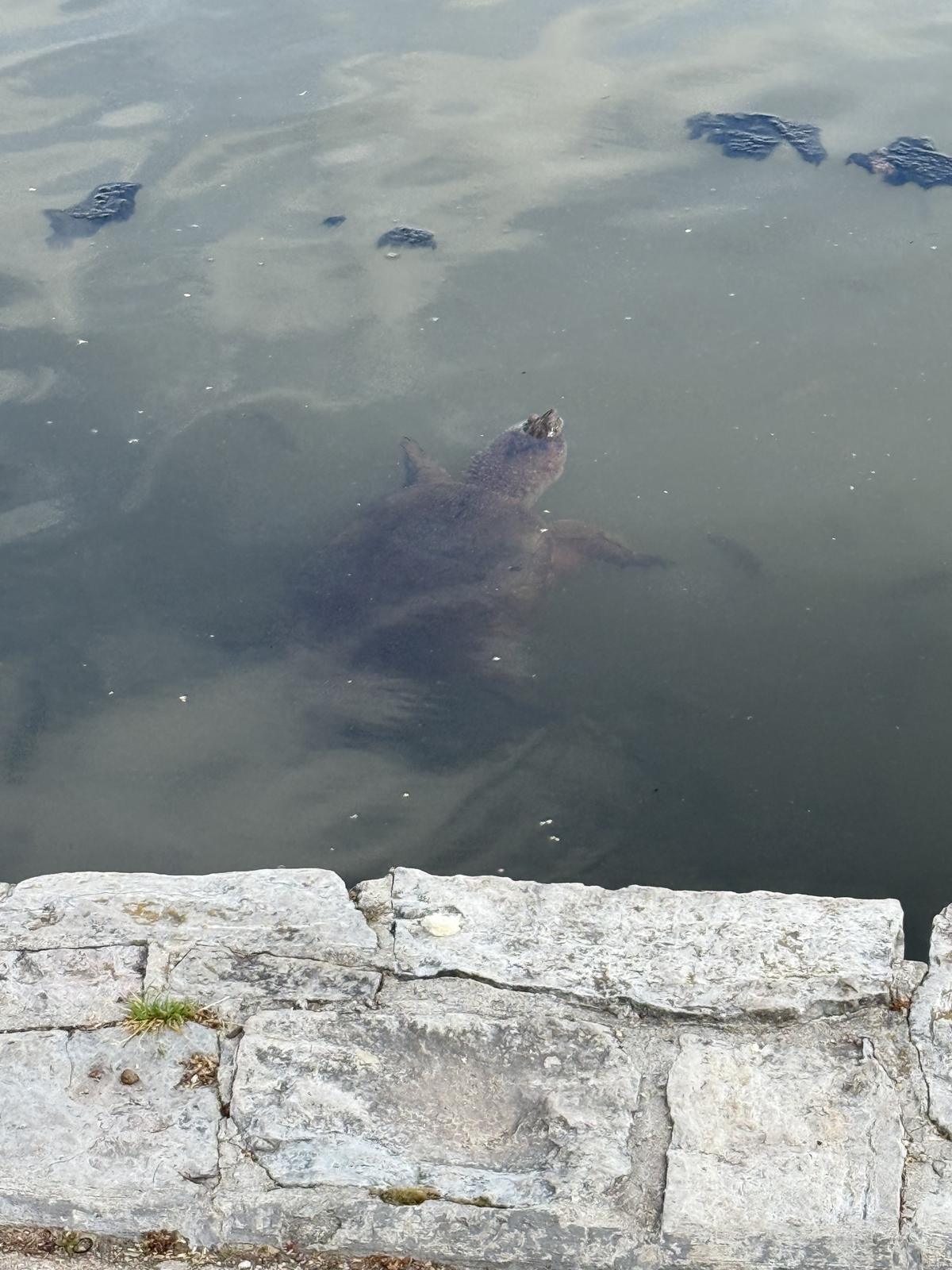
In the photographs referred to below there are two things which four years' worth of catch records fail to mention. The first of these is a school of small fish at the surface—a size class that a baited hook is simply incapable of catching. The second is a snapping turtle, an aquatic predator that is hunting the same animals which this study was counting.

This example is the best on the website of a limitation which is mentioned throughout the site: the account explains what takes a hook from one section of bank, and that is a far narrower matter than what exists in the pond.

An honest catch log cannot be considered a census, and the gap in question is considerable. The fact that dozens of small fish are seen in a single frame while only eleven golden shiners are recorded in the entire account, together with a predator large enough to eat them which is completely absent — this is the most straightforward way of illustrating the point, which is why these photographs are being published rather than being kept as off-topic.
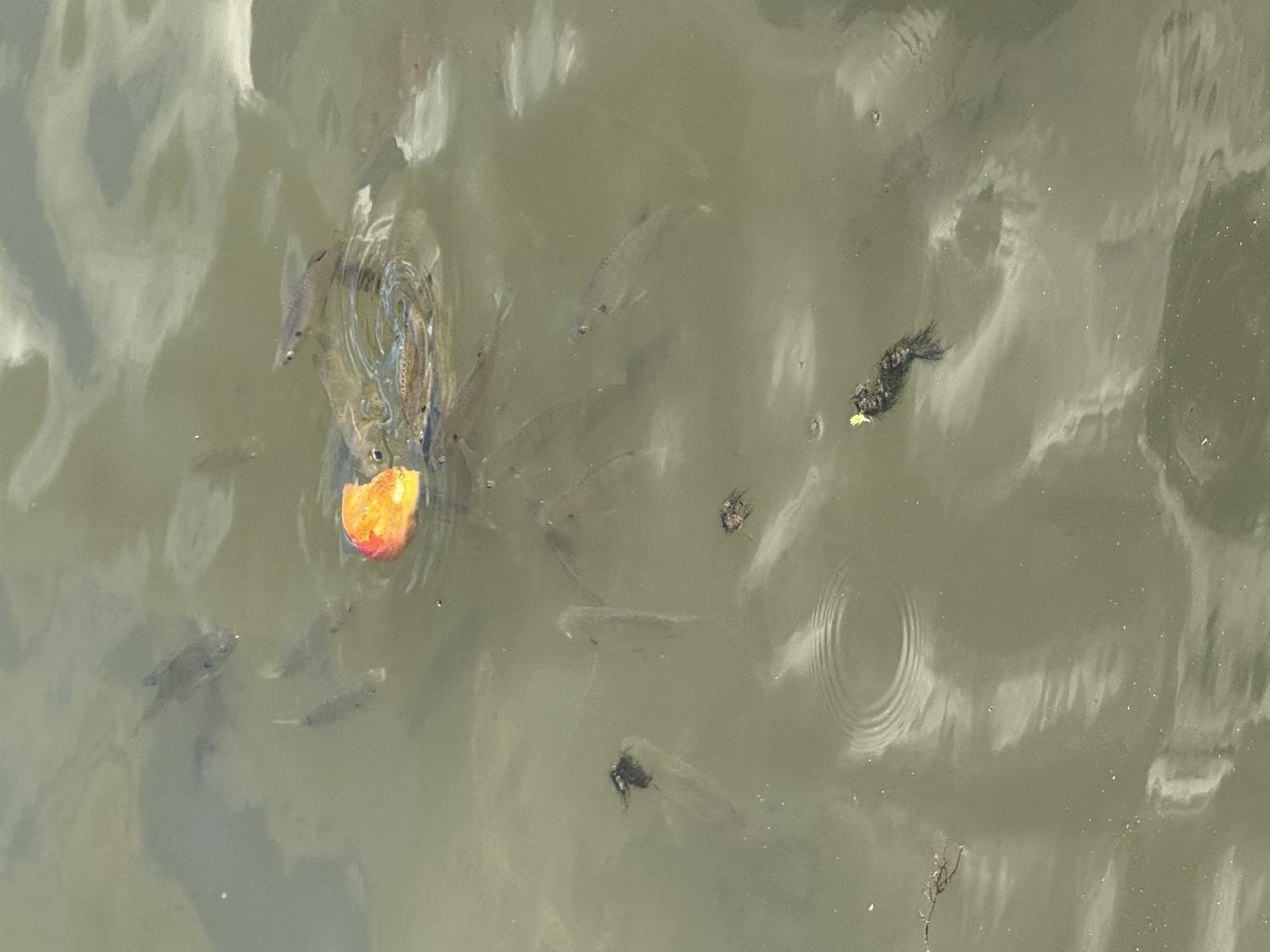
A school of small silvery fish gathered at the surface of murky green water around a floating piece of bread.
The fish the hook never reachesA dozen or more small fish crowding a scrap of bread at the surface. Nothing this size takes a baited hook, so almost none of these animals appear anywhere in four years of records. Golden shiner — the one small species in the log — totals eleven fish.
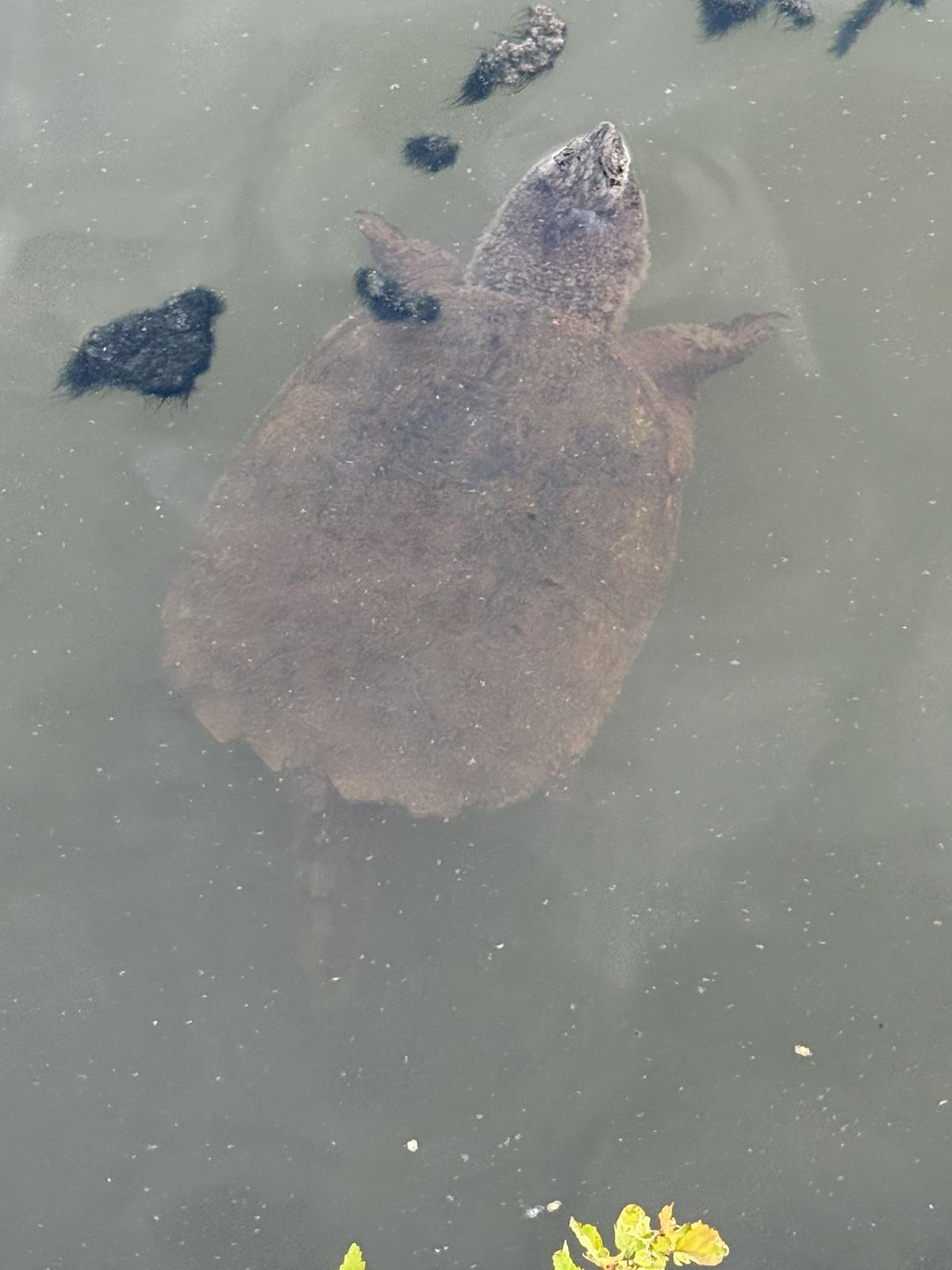
A large turtle just below the surface of murky water, head raised, with a rough ridged shell.
Snapping turtle at the surfaceRough ridged carapace, heavy head, pointed snout — consistent with a common snapping turtle. A large aquatic predator that takes fish among much else, living in the pond throughout the study and appearing nowhere in the data.
A snapping turtle seen from above through green water, long tail extending behind its rough oval shell.
The same animal, closerThe long thick tail trailing behind the shell is the clearest snapping-turtle feature visible here. Nothing in the sampling method could have detected this animal. It was seen because someone was standing on the bank looking at the water.
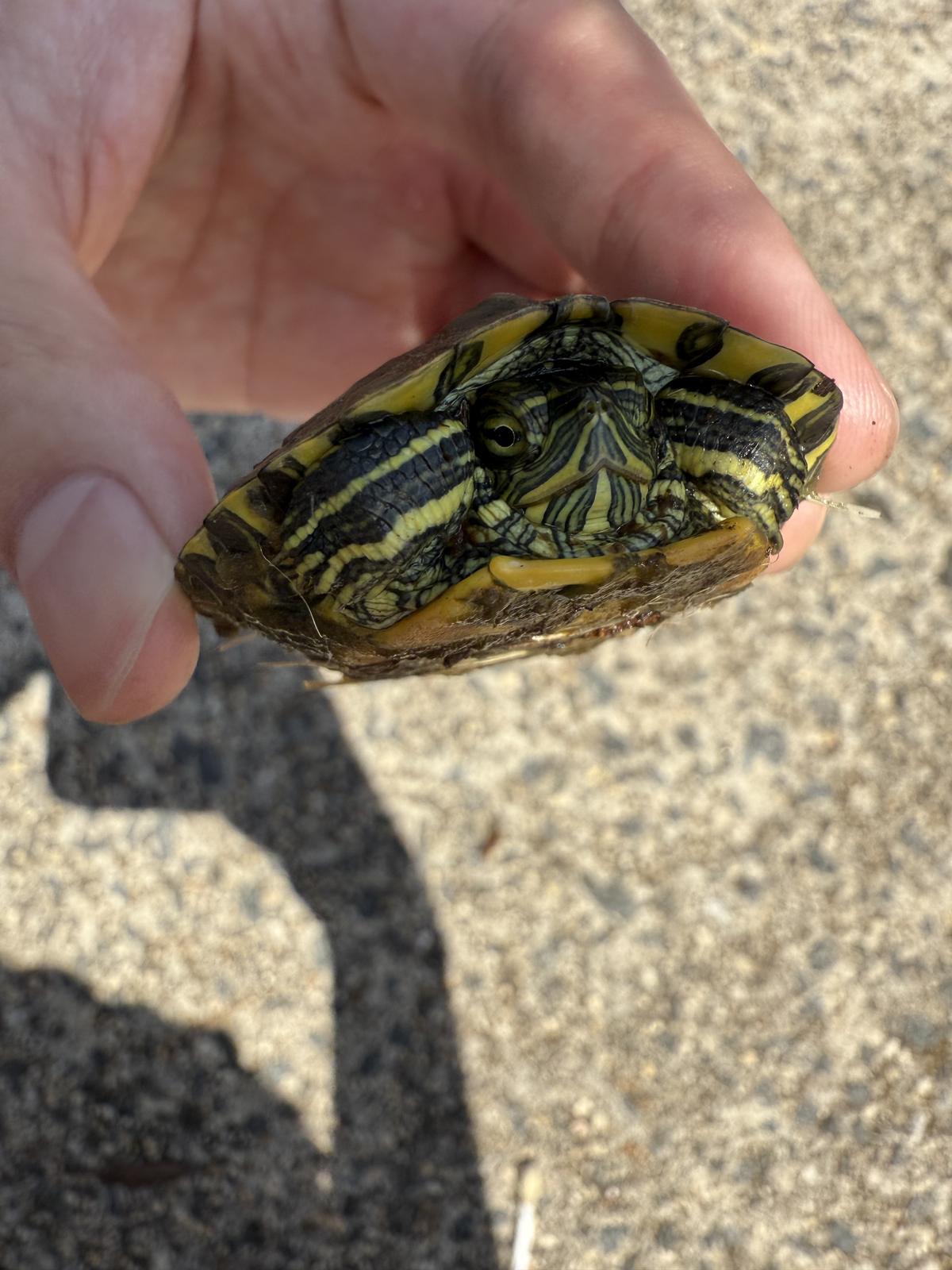
A small turtle held in a hand, head withdrawn, showing bold yellow and black stripes on head and neck.
A smaller turtle in the handBold yellow and black head striping. Not identified to species — painted turtle and pond slider both occur in Northern Virginia, and separating them needs a clear view of shell and plastron.
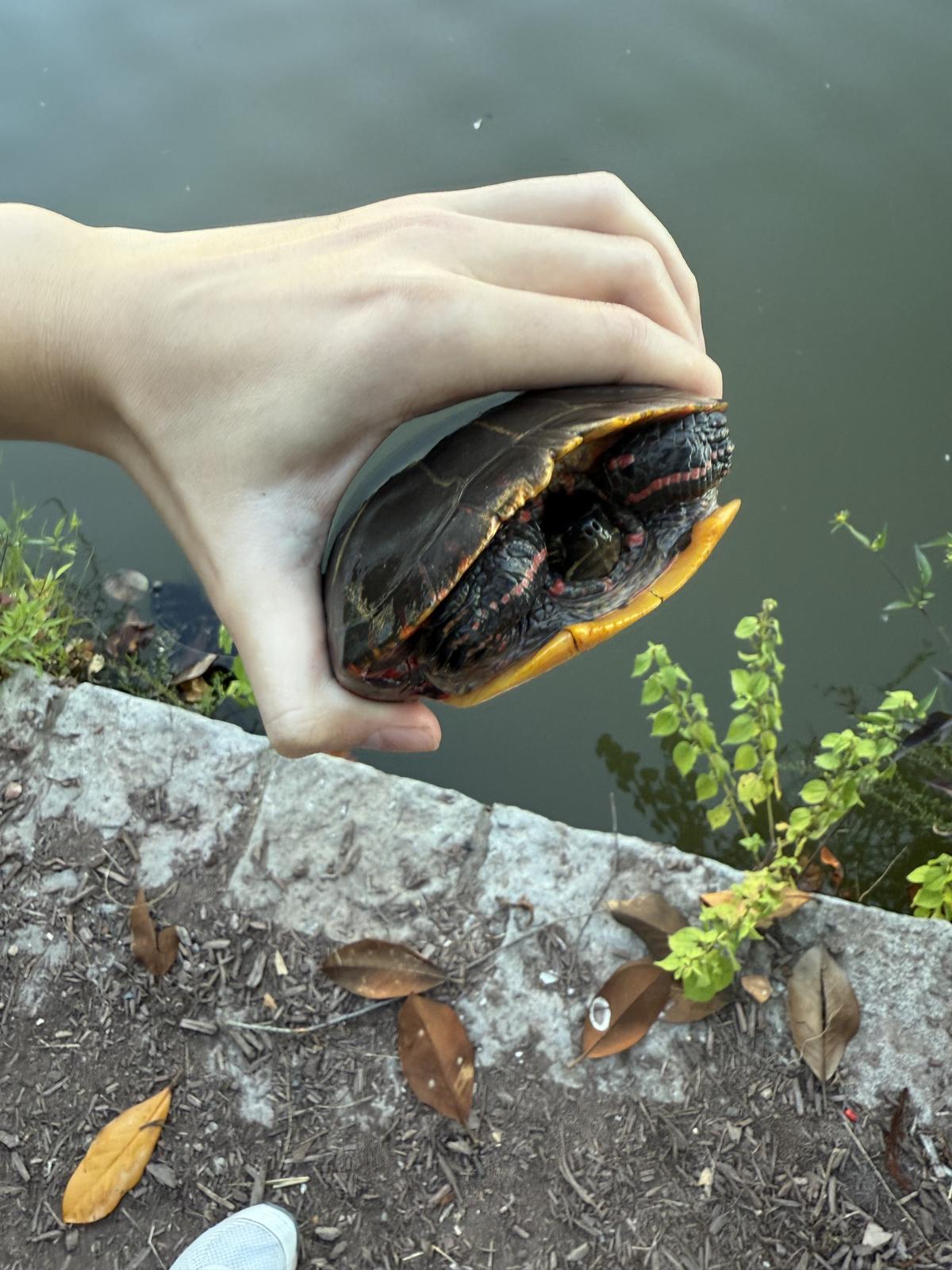
A turtle held above the pond edge showing red markings along the rim of its shell and a yellow-orange plastron.
Shell markingsRed bars along the marginal scutes with a yellow-orange underside. A red-eared slider would be a released pet and non-native to Virginia; an eastern painted turtle would be native. The photograph is not enough to settle which.

On identification

The individual who caught them was able to identify the species without using a identification key and usually did so within a few seconds; in fact it is quite difficult to distinguish between sunfish of the genus Lepomis since their colour varies with sex, season and stress, there is overlap in appearance between several species and they easily hybridise in small ponds.

If a photograph by itself is not enough to confirm what was recorded, the caption is used to make this point rather than providing a more detailed account with a degree of confidence that the image does not justify.

Corrections welcome
If you are able to name the animal in this instance more accurately than the caption does — or if you believe that it has been misidentified — then please let us know by using the review form on the papers page. The corrections will be included with the photograph and the figures will be altered if the correction has an effect on them.